
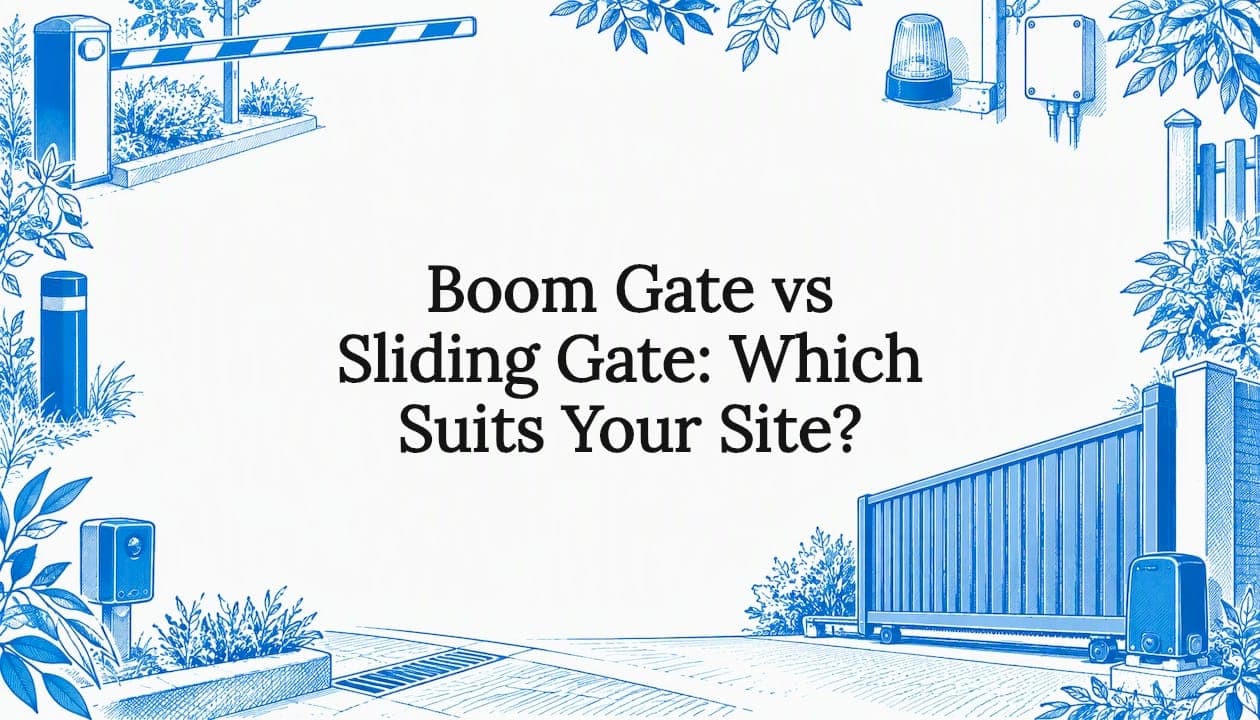
A boom gate controls a lane of traffic with a pivoting arm. A sliding gate closes the whole opening with a solid panel. If your priority is moving lots of vehicles through quickly, such as a car park, loading dock or apartment entry, a boom gate usually fits. If your priority is physically closing off a property, such as a home, a yard or an industrial compound, a sliding gate usually fits. Most sites decide on three things: how many vehicles pass each hour, what you need to keep out, and what the ground and space around the entrance allow.
This guide compares the two on the criteria that matter, shows where each one goes wrong, and covers the safety and maintenance duties Australian gate owners carry.
TL;DR
- Boom gates are built for speed and volume. They are a traffic-control device, not a barrier to people on foot or a closed boundary.
- Sliding gates close the full opening, so they suit security-first sites, sloping driveways and places with wind exposure.
- A sliding gate needs a clear run beside the opening, and tracked versions need a clean track. Cantilever designs avoid the track.
- Neither type is "set and forget". The owner is responsible for maintenance, safety testing and instructing users.
- Many commercial sites combine both: a boom at the entry lane and a sliding gate on the secure perimeter.
Table of Contents
- What each gate actually does
- Boom gate vs sliding gate at a glance
- Speed and traffic volume
- Security
- Space, slope and wind
- Maintenance and running costs
- Safety: the part buyers skip
- Which one for which site
- Our perspective
- Planning your gate with us
- What to bring to the first conversation
- FAQ
- Sources
What each gate actually does
The two are often compared as if they were rivals, but they solve different problems.
A boom gate (also called a boom barrier) is a horizontal arm on a pivot housed in a cabinet. It lifts to let a vehicle through and lowers behind it. It controls vehicle flow in a single lane. It does not close off the space either side of the arm unless fencing or bollards do that job.
A sliding gate is a solid or open-frame panel that travels sideways, parallel to the fence line. It runs either on a ground track or as a cantilever, where the gate is carried on rollers mounted on posts and stays clear of the ground. When closed, it fills the whole opening.
That one difference, an arm versus a full barrier, drives almost every other point below.
Boom gate vs sliding gate at a glance
| Criteria | Boom gate | Sliding gate |
|---|---|---|
| Opening speed | Very fast, often a few seconds | Slower, as the whole panel travels |
| Best for | High-traffic car parks, estates, depots, ticketed or tag-controlled lanes | Homes, secure yards, industrial compounds, sloping sites |
| Physical security | Low on its own, controls vehicles only | High, closes the entire opening |
| Space needed | A cabinet beside the lane and room for the arm to rise | A clear run alongside the opening, roughly the gate's width |
| Slope | Arm length and balance need care, but no ground sweep | Handles gradients well, as it does not swing |
| Wind | Slim arm, little wind load | Solid panels catch wind, but the load is managed by the design |
| Maintenance | Lower | Higher, especially for tracked gates |
| Appearance | Utilitarian | Can be custom designed to match the property |
Speed and traffic volume
This is where the boom gate wins clearly. Industry reporting on a recent brushless boom barrier release puts opening times for a 3 to 4 metre arm at roughly 1 to 4 seconds, with some high-performance models reaching about a second on a 3 metre arm and standard models taking 2 to 6 seconds or more. A sliding gate has to move an entire panel across the opening, so it cannot match that.
Why it matters in practice:
- Queues. At a car park with a morning rush, a slow gate backs traffic onto the street. A boom keeps the line moving.
- Duty cycle. High-traffic barriers are rated by cycles. The same source distinguishes standard duty models rated to around 2 million cycles from intensive duty models rated to around 5 million, and notes brushless motors as a common upgrade for reliability and speed control in heavy use.
- A house is different. A family driveway sees a handful of cycles a day. A few extra seconds of opening time costs you nothing, and the security gain outweighs it.
Security
A boom arm stops a vehicle that is not meant to enter. It does not stop a person walking around it, and a determined driver can damage or bypass a light arm. If you need to secure a boundary, a boom gate needs fencing, bollards or a pedestrian gate alongside it to do that work.
A sliding gate closes the full width. Built in steel or wrought iron and paired with matching fencing, it forms part of a continuous perimeter. That is why sliding gates are the usual choice for yards holding equipment, stock or vehicles, and for homes where the gate is the visible front line.
For access control, both work with the same tools: remotes, keypads, intercoms, tag or card readers, number plate recognition and loop detectors. If you are planning that layer, our guide to integrating gate access control without rework covers what to decide before the gate is built.

Space, slope and wind
This is where site conditions overrule preference.
Gate Safe's commercial guidance says a sliding gate is often the right choice on a gradient or where wind loading has to be managed, while a boom gate is preferred when space near the entrance makes a sideways track run impractical. The same guidance contrasts these with swing gates, which are more affected by wind.
In practice:
- Measure the run. A sliding gate needs a clear length beside the opening for the panel to retract into. If a retaining wall, garden bed, tree or neighbouring structure is in the way, a slider may not fit.
- Check the fall. A sloping driveway rules out many swing gates because the leaf would scrape. A slider runs along the fence line and avoids that. See our checklist for gates on sloped driveways.
- Think about wind. Solid panels in exposed positions need proper structural design. An open-frame wrought iron slider lets wind through.
- Allow for the lane. A boom needs room for the cabinet, the arm's swing upward and a safe stopping position for vehicles on each side.
If you do have the room for a slider, our article on sliding gate design, track, slope and safety goes through the details before style comes into it.
Maintenance and running costs
The research here is consistent: sliding gates need more ongoing attention. Gate Safe's guidance points to the ground track, which must be kept free of debris to avoid motor wear and alignment problems, and cantilever designs are often recommended over tracked ones for that reason.
In a Victorian setting that means leaves, gravel, mulch and dirt from a driveway all end up in a track. Cantilever sliders avoid the track but need well-built posts and footings, since the whole gate hangs from them.

Booms have fewer moving parts exposed to the ground, so they typically ask less of you. They are still mechanical devices. Arms get hit, springs and balance need checking, and the safety sensors must keep working.
If an existing gate is misbehaving, our quick checks to tell mechanical from electronic faults will save you a call-out on the simple causes.
Safety: the part buyers skip
Both gate types can hurt people. Common hazards include crushing, shearing, impact, drawing-in and entrapment, all covered in the BFT Australian and New Zealand safety guidelines.
What to ask for from any installer:
- Layered protection. One device, such as a single photocell, is not enough. Safety edges, correctly positioned sensors and force limiting should work together. Sliding gates in particular create shearing and drawing-in points along the leading edge and at the fixed posts.
- Compliance with the right standard. Electric drives for gates sit under the AS/NZS 60335 series, with IEC 60335-2-103 covering drives for horizontally and vertically moving gates for household and similar purposes.
- Manual release. Everyone who uses the gate should know how to operate it by hand during a power failure.
The Fencing Industry Australia code of practice for gates and automation aims to set a consistent national framework for safe design, installation, operation and maintenance. Under that framework the gate owner stays responsible for keeping the system maintained, testing it regularly and making sure users are instructed. If you manage a commercial site, a strata property or a rental, that responsibility is yours, not the installer's, once the job is handed over. Ask your installer for a written maintenance schedule at handover.
Which one for which site
A suburban home
A sliding gate, usually. It closes the whole opening, copes with slopes and looks good in steel or wrought iron. Before choosing, measure your widest vehicle and the clear run beside the entry. Our guides on driveway gate width and long driveway access show how to do that. A boom gate rarely suits a house, since it provides no real boundary.
An apartment building or townhouse complex
A boom, a slider or both. Gate Safe's guidance and industry commentary favour booms where quick opening and heavy resident traffic matter. Where you also need to stop pedestrians tailgating, pair the boom with a pedestrian gate or choose a fast slider on the secure line.
A commercial car park
A boom gate. Fast cycles, ticket or tag integration and low maintenance suit the job. Add fencing wherever the boom does not span.
An industrial yard or depot
A sliding gate, ideally a cantilever, in heavy-duty steel. It secures the full boundary after hours. Some depots add a boom on the entry lane for daytime traffic control, with the slider closed overnight.
A mixed site
Use both. A boom handles the visitor lane or the daytime flow, and a slider seals the perimeter. This costs more than one gate but matches how the site works.
Our perspective
We have built custom gates in Victoria for over 30 years, and the question we hear most is "which is better?" The honest answer is that we start with the site, not the product.
When homeowners ask, we usually end up at a sliding gate because their priority is a closed boundary and a good look at the street. We walk the driveway, check the fall and the run beside the opening, and talk through a cantilever versus a track. We would rather spend an hour on the site than sell a gate that jams in its first winter.
For commercial and industrial clients, we ask about vehicle numbers, who needs to come in, and what the site holds. Sometimes the answer is a boom. Often it is a mix. What does not change is that safety devices and maintenance are planned at the design stage, not added later.
We design, handcraft and install in-house using Australian-made, locally sourced materials, so what we draw is what gets built. Please bring us your measurements and photos, even rough ones.
— Rhys
Planning your gate with us
If you are weighing up a boom or a slider for a property in Victoria, we can help with the whole job: design rendering, fabrication, installation, and repairs and maintenance afterwards.
- Homes: residential gates and fencing
- Car parks, depots and industrial sites: commercial and industrial gates, fencing and automation
- Motors, keypads, intercoms and sensors: automation and access controls
- Custom steel or iron designs: request a design consult
If you want to see styles first, our driveway gate ideas with installer notes and the driveway gate lighting checklist are good starting points.
What to bring to the first conversation
You will get a more useful quote if you have these ready:
- Photos of the entrance from the street and from inside the property.
- The opening width and the clear space on each side.
- The slope across and along the driveway, even as an estimate.
- The number of vehicles per day and the largest vehicle that needs to enter.
- Who needs access: residents, staff, deliveries, visitors, trucks.
- Any existing fencing, walls or services (power, conduit, drainage) near the gate.
- Whether you need access control such as a keypad, intercom, tags or number plate recognition.
That list lets a designer rule out options quickly and cost the right one.
FAQ
Is a boom gate cheaper than a sliding gate?
Usually the boom unit itself is simpler, since it is an arm and a cabinet rather than a fabricated panel with posts, footings and a track or cantilever frame. Total cost depends on the site, the access control, the safety devices and any fencing needed beside the boom. Get quotes for the complete solution, not just the hardware.
Can a boom gate secure a property?
Not on its own. It stops vehicles in one lane but leaves the rest of the boundary open to people and to anyone who goes around it. To secure a site, combine the boom with fencing, bollards and a pedestrian gate, or choose a sliding gate that closes the full opening.
Which needs more maintenance, a boom or a slider?
Sliders, in general. Tracked versions need the track kept clear of debris to avoid motor wear and alignment problems, and cantilever gates are often recommended to reduce that. Both types need regular safety testing and servicing.
Do I need a licensed installer for an automatic gate in Victoria?
The electrical work on a gate motor must be done by a licensed electrician, and the safety setup should follow the relevant standards and industry guidance. Ask your installer to confirm what applies to your job and to give you a handover record. For rules specific to your property, such as fence height or council permits, check with your local council.
Sources
- CAME releases GARD PT and GARD PX brushless boom barriers, SEN.news
- Automatic gates: guidance for commercial sites, Gate Safe
- Code of Practice for Gates and Automation, Fencing Industry Australia
- Australian and New Zealand automatic gate safety guidelines, BFT
- IEC 60335-2-103:2023, IEC Webstore