
Most single driveway gates commonly range in width from about three to slightly over three and a half metres, while double-leaf gates generally span from about five to six metres. The sizing rule that matters more than any chart: measure your widest regular vehicle, add clearance for mirrors and the approach angle, then check whether a pool barrier or emergency-access minimum applies to your property.
TL;DR:
- Measure your widest regular vehicle, add 150 to 200 mm for mirrors, and check local pool and emergency access requirements before choosing gate width.
- Single gates are best between 3.0 and 3.6 meters depending on vehicle size, approach angle, and driveway curvature, with extra clearance needed for mirrors and hinges.
- Double gates typically range from 4.8 to 6.0 meters, ideal for two-way traffic, larger deliveries, emergency access, and reduced hinge strain, especially on wider properties.
- Proper measurements include the actual opening between posts and the full turning path for angled approaches, with video recordings recommended for accuracy.
- Site-specific factors like slope, approach angle, and future vehicle upgrades strongly influence whether a custom fabricator should be engaged over standard-sized solutions.
Table of Contents
- Why driveway gate width matters for access, safety and future-proofing
- Single driveway gate: common widths and how to choose the right size
- Double driveway gate: typical openings and when a double leaf is better
- Clearance and measuring: how to record the dimensions a supplier needs
- Sliding versus swing: how operation changes width and site requirements
- Common mistakes to avoid when choosing or measuring gate width
- When to choose a custom gate or professional automation
- The bottom line on driveway gate width
- Local building codes and regulations affecting gate width
- Considerations for future expansion or vehicle upgrades
- Impact of gate width on automation options and hardware compatibility
- An editorial take on getting driveway gate width right
- Get your driveway gate width right the first time
- Sources
Why driveway gate width matters for access, safety and future-proofing
Get the width wrong and you find out the hard way, usually with a wing mirror or a scraped gate post. Width affects far more than whether a car fits through the opening. It determines how easily you can manoeuvre at speed on a wet morning, how much clearance you have from mirrors and gateposts, and whether a delivery truck or trailer can get in without a three-point turn from the street.
Approach angle and turning radius usually matter more than raw vehicle width. A ute driving straight in off a wide, flat street needs less width than the same ute turning in from a narrow road at an angle.
Oversizing has its own costs. Wider gates cost more to build, need heavier automation, and can look out of proportion on a modest block. Still, it pays to think ahead:
- Will you upgrade to a larger vehicle, caravan, or boat trailer in the next five to ten years?
- Do delivery vans, bins trucks, or tradies' utes need regular access?
- Could a future subdivision or granny flat add a second regular vehicle?
Single driveway gate: common widths and how to choose the right size
A single-leaf gate suits most suburban blocks with one main vehicle entry. The trick is matching the opening to your actual traffic, not just the widest car you own today.
- 3.0 metres covers most passenger cars and smaller SUVs with a straight approach. This is the baseline width recommended across industry guidance for standard driveway gates.
- 3.3 to 3.6 metres suits households with a larger SUV, a ute with tray mirrors, or a driveway that curves before reaching the gate. Guidance on driveway gate sizing puts this range at roughly 10 to 12 feet, which lines up with the metric figures used locally.
- 3.6 metres and above becomes worthwhile if you regularly bring in a van, a small box trailer, or a boat on a trailer, even if that only happens a few times a month.
Whatever width you land on, add clearance on top of the raw vehicle measurement. Mirrors typically add 150 to 200 mm per side beyond the body width, and gateposts or masonry columns eat into the usable gap. A gate advertised as "3.0 m" is usually the opening between posts, not the true drivable width once hinges and latches are fitted, a distinction worth confirming before you order.
If your approach comes in at an angle rather than square to the gate, add extra width on the side the vehicle swings toward. It's a cheap fix at the design stage and a genuinely awkward one to retrofit.
Double driveway gate: typical openings and when a double leaf is better
Double-leaf gates open up options a single gate can't match, mostly around traffic flow and load distribution on the hinges.
Typical combined openings run from 4.8 to 6.0 metres, occasionally stretching to around 9.75 metres on rural or commercial properties, based on common industry ranges for wider gate installations. Leaves don't need to be split evenly. A common approach is one narrower leaf for everyday pedestrian-style use and one wider leaf that opens only when a second vehicle or larger delivery needs through.
Reasons to choose double over single:
- Two-way traffic at properties with multiple vehicles coming and going during the day.
- Delivery and trade access where trucks need a wider berth than a single leaf can offer without going full width.
- Emergency access, since a double gate can be configured so at least one leaf opens fully even if power or automation fails on the other.
- Structural sense, since two shorter leaves put less strain on hinges and posts than one very long single leaf trying to span the same opening.
Commercial-width gates, generally anything beyond 6 metres, bring extra considerations. Check for underground services before excavating for footings, confirm council setback requirements, and factor in whether the site can handle the swing or slide path a gate that size actually needs.
Clearance and measuring: how to record the dimensions a supplier needs
The "opening width" and the "gate-leaf width" are not the same number, and mixing them up is the single most common ordering mistake homeowners make. The opening is the clear space between your posts or columns. The leaf is the physical gate panel, which needs to be slightly smaller to allow for hinges, a latch mechanism, and a closing gap.
- Measure the opening at three points, top, middle, and bottom, since older posts and uneven ground can throw out a single measurement by several centimetres.
- Allow 30 to 50 mm beyond the nominal opening for hinge and latch clearance, a figure consistent with standard practice for residential gate sizing in Australia.
- Set ground clearance at 50 to 100 mm under the bottom rail, enough to clear drainage and gravel without leaving a gap a determined pet can squeeze under.
- Walk the actual turning path for angled or curved approaches, measuring from the tightest point a vehicle's mirror or tray would pass, not just the straight-line distance between posts.
- Photograph the approach from the street and from inside the property, including any nearby power poles, meter boxes, or garden beds that could constrain the swing or slide path.
Pro Tip: Send a supplier a short video walking the approach at driving pace, not just still photos. It shows the actual turning arc a car or trailer needs to take, which is often tighter or wider than it looks from a single snapshot.
A narrow driveway article from Easton Fencing covers useful workarounds for sites where the street frontage itself is the limiting factor, not the gate design.
Sliding versus swing: how operation changes width and site requirements
The two main gate types don't just look different, they need completely different amounts of usable side space, and that changes what width is actually achievable on a tight block.
- Sliding gates need side-stowage roughly equal to the full gate width, plus extra allowance if the system uses a cantilever tail or a ground track. A 4-metre sliding gate on a cantilever system might need close to 5 metres of clear fence line to park against.
- Swing gates need an open arc, generally the full leaf length swept in a quarter circle, and that arc has to stay clear of parked cars, garden beds, or a sloping driveway.
- Sloped sites favour sliding gates, since a swing gate's bottom edge can catch on rising ground partway through its swing.
- Windy sites also tend to favour sliding over swinging, since a wide swing leaf acts like a sail in strong gusts.
- Automation placement matters too. Motor housings and control boxes for sliding and swing gate automation need their own clearance, which can quietly eat into the width you thought you had available.
Common mistakes to avoid when choosing or measuring gate width
Most gate sizing errors come down to skipping one of a handful of checks, and they're avoidable once you know to look for them.
- Confusing opening width with leaf width, then ordering a gate that's technically too tight once hinges and a latch are fitted.
- Ignoring the approach angle, assuming a straight-line measurement is good enough when the actual vehicle path curves or turns in.
- Skipping a real turning-path test, rather than just eyeballing whether a car "looks like it fits."
- Overlooking pool barrier or accessibility rules. A pedestrian gate near a pool needs to meet AS1926.1, which sets a minimum 1200 mm height and maximum 100 mm gaps, while accessible gates need a minimum 850 mm clear opening under AS1428.1.
Emergency-access rules add another layer many homeowners miss entirely until a fire authority or council flags it during a build application, which is exactly the kind of costly rework a five-minute check up front avoids.
When to choose a custom gate or professional automation
Complex approaches, heavy regular vehicles, pool barriers, or accessibility needs are the clearest signals it's time to bring in a fabricator rather than guess from a supplier's size chart. A steep driveway, a curved entry, or a block backing onto a shared right-of-way all throw up site-specific problems a generic width table can't solve.
On site, a professional typically checks:
- The true opening at multiple heights, not just a single tape measurement.
- The full turning path for your actual vehicles, including trailers or vans.
- Ground clearance and slope, particularly where a sliding gate's track needs to sit level.
- Compliance points such as AS1926.1 for pool-adjacent gates and any local emergency-access requirement.
Victorian Gate Automation has spent over 30 years handcrafting gates, fencing, and access control systems across Victoria, working from locally sourced materials and site measurements rather than off-the-shelf assumptions. That approach shows up in completed residential and commercial projects built to the actual dimensions of each property, not a generic template.
The bottom line on driveway gate width
Size your gate to your widest regular vehicle, add clearance for mirrors and the approach angle, then confirm against any pool or emergency-access minimums. From there: measure the opening properly, check local rules, and get a written quote before committing to a width.
Local building codes and regulations affecting gate width
Council and state rules can override any "standard" width you find in a supplier's brochure, and they're worth checking before you finalise a design, not after. Setback requirements often dictate how close a gate can sit to the street boundary, which in turn affects how much swing or slide clearance you actually have to work with.
Emergency services guidance is a separate and often overlooked layer. CFA Victoria's property access advice stresses that fire and emergency vehicles need unobstructed access, and some council or brigade guidance sets minimum passage widths or approach requirements for properties in higher-risk zones. A gate that looks generous on paper can still fail this check if the approach path narrows or if gateposts sit too close to the running line.
Pool safety compliance is the other big one. Any gate that forms part of a pool barrier must meet AS1926.1, which sets minimum height, maximum gap sizes, and self-closing, self-latching hardware requirements regardless of how wide the vehicle gate itself is. If your driveway gate doubles as part of the pool enclosure, it needs to satisfy both the vehicle-access sizing and the pool compliance rules at once.
Accessibility requirements matter too, particularly for properties with a secondary pedestrian gate. AS1428.1 sets a minimum 850 mm clear opening for accessible gates, a figure worth checking against any pedestrian-only side gate you're planning alongside the main vehicle entry.
Before finalising any width, a quick call to your local council building department or the relevant fire authority can save a costly redesign later.
Considerations for future expansion or vehicle upgrades
A gate sized perfectly for today's car can become a daily headache the moment you upgrade to something larger. Think about where your household is heading over the next five to ten years, not just what's parked in the driveway right now.
Caravans and boats are the classic trap. A family that buys a caravan two years after installing a 3.0 metre gate often finds themselves unhitching at the street and walking it in by hand, which gets old fast. If a bigger tow vehicle or trailer is even a possibility, building in an extra 300 to 600 mm now costs far less than a full regate later.
Household growth matters too. A second driver, a young adult buying their first car, or a home business bringing in regular deliveries can all quietly increase how often larger vehicles need to pass through. Granny flats and secondary dwellings, increasingly common on suburban blocks, often bring a second regular vehicle with them.
It's also worth thinking about trade and service access. Tree removal trucks, moving vans, and even standard furniture deliveries are wider than most people expect, and a gate that's marginal for these vehicles turns routine visits into logistics problems.
None of this means everyone should build the widest gate they can afford. It means factoring likely change into the decision now, while adjusting a design on paper is cheap, rather than after the posts are set in concrete.
Impact of gate width on automation options and hardware compatibility
Width doesn't just affect what fits through the gate. It determines which motors, tracks, and control systems are actually viable, and getting this wrong after installation is expensive to fix.
Sliding gate motors are rated by weight and length, and a wider leaf generally means a heavier leaf, which pushes you toward a more powerful motor and a sturdier track or cantilever system. Push a standard residential motor beyond its rated width and you get slow operation, premature wear, or outright failure within a year or two.
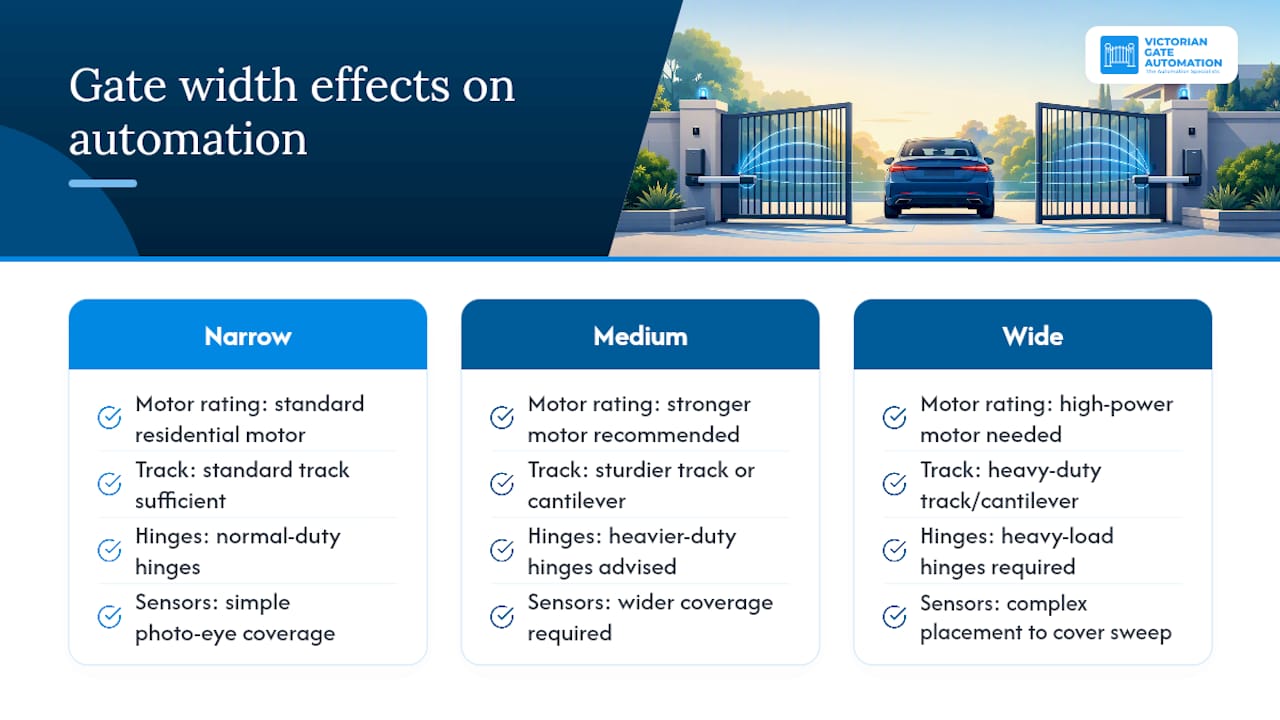
Swing gate automation has its own width ceiling. Longer arms need more torque to swing a heavier leaf through its full arc, and very wide single-swing leaves can become impractical to automate reliably at all, which is often the point where a double-leaf design starts making more sense than pushing a single gate wider.
Hardware compatibility extends to hinges, latches, and safety sensors too. Wider gates need heavier-duty hinges rated for the extra load, and photo-eye safety sensors need to be positioned to cover the full swept area without gaps, something that gets more complicated as width increases.
Automation and access control systems built around the specific width and weight of a gate tend to last longer and need less ongoing maintenance than a generic motor forced to work outside its design range. If you're planning to automate later rather than now, it still pays to choose a gate width with automation limits in mind from day one.
An editorial take on getting driveway gate width right
Most gate width advice online treats the headline range, "3.0 to 3.6 metres for a single gate," as the whole answer. It isn't. The number that actually determines whether your gate works day to day is the approach angle, and almost nobody talks about it with any specificity.
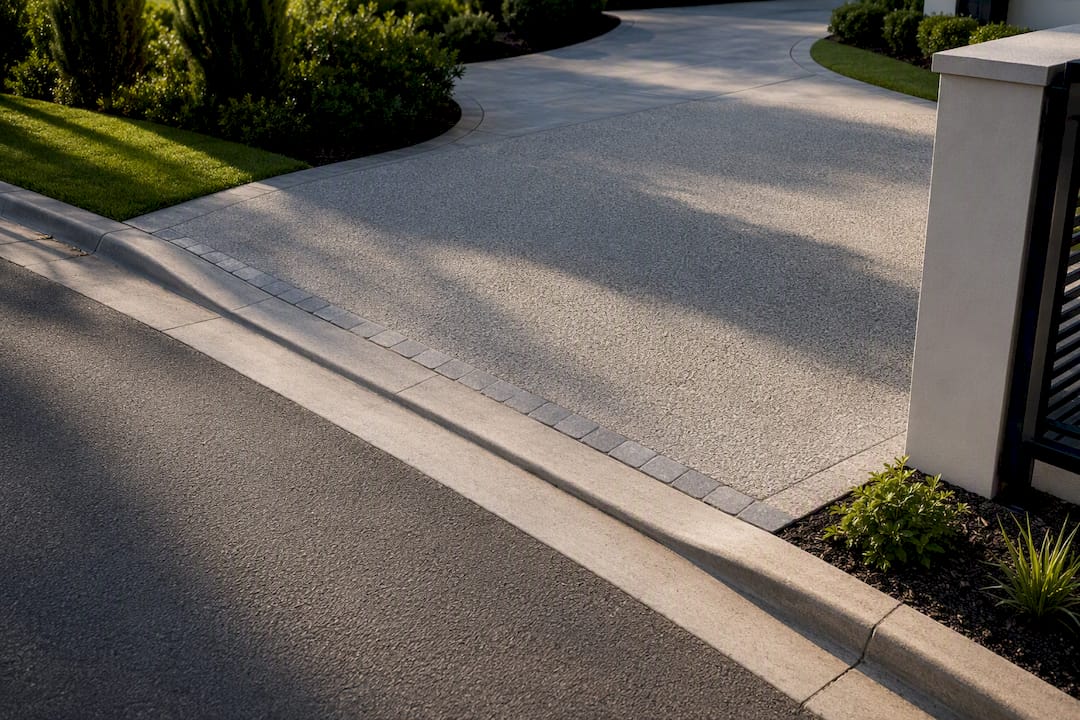
I'd argue the conventional advice has the emphasis backwards. Homeowners fixate on getting the widest gate their budget allows, when the real risk sits in the turning path, not the raw opening. A 3.0 metre gate on a dead straight approach often outperforms a 3.6 metre gate on a tight, angled entry, because the second one still can't be driven through cleanly at any width without a three-point manoeuvre.
If you take one thing from this, walk your actual turning path before you settle on a number, ideally with the vehicle you drive most often. Photograph it. Video it if you can. Then bring that to whoever measures your site, because a fabricator working from a real approach beats one working from a brochure chart every time.
— Rhys
Get your driveway gate width right the first time
Guesswork on gate width is expensive to undo once posts are set and a motor is fitted. A practical alternative to sizing off a generic chart is choosing a handcrafted gate made to the actual measurements of your driveway, rather than a standard template pulled from a catalogue.

That matters most when your approach is angled, sloped, or shared with a pool barrier or emergency-access requirement, exactly the scenarios where a generic width guide falls short. Vicgates has spent over 30 years fabricating custom gates, fencing, and automation and access control systems for homes and properties throughout Victoria, using locally sourced materials built to last.
If you're planning a new gate or checking whether an existing opening still suits your vehicles, get a proper site measurement and a written quote before you order anything. Start with Vicgates' residential gate services to arrange a measure and a straightforward quote for your property.
Sources
- Standard pedestrian gate sizes in Australia | CAD60
- How wide are standard driveway gates | Southland Fence
- How wide should a driveway gate be? | Zimmer Gates & Doors