
The best driveway gate lighting layers three elements: pillar or bollard markers for the entrance, a sensor flood for security, and a backlit address sign for wayfinding. Go solar where mains power is limited and hardwired where you want integrated, dimmable security lighting tied to your gate automation. Use the checklist further down to brief a supplier, or book a site visit with a professional installer to get it right the first time.
TL;DR:
- Solar lighting is suitable if trenching mains power is costly or difficult, but hardwired systems offer more reliable, dimmable security lighting and better integration.
- Placement of bollard and inground lights every 2 to 3 meters along driveway edges improves safety and aesthetic layering, with high-mounted floodlights providing targeted security illumination.
- Lighting fixtures should have an IP65 or higher rating for outdoor exposure, and choosing proper kelvin temperature and lumens ensures both welcoming and security-effective illumination.
- Motion sensors should be carefully tuned to avoid false triggers, while glare control is achieved through shielded fixtures, downward aiming, and proper mounting height.
- Hardwired illuminated address numbers are more reliable and should be installed by a licensed electrician, while solar options are easier but require checking visibility from the street after dark.
Table of Contents
- Which driveway gate lighting fixtures suit which job?
- Where should you place driveway lights for the best effect?
- Should you choose solar or hardwired gate lighting?
- What colour temperature and brightness work best?
- How do motion sensors and glare control improve safety?
- Do illuminated address numbers actually help?
- What should you check before buying driveway lights?
- What an installer sees on-site that homeowners often miss
- Get driveway gate lighting designed and installed properly
- Sources
- FAQ
Which driveway gate lighting fixtures suit which job?
Not every fixture does the same job, and mixing types is usually smarter than relying on one bright light. Here's what each one is actually for:
- Pillar or column lights — mark the entrance clearly and boost address visibility from the street.
- Bollard lights — line the driveway edges so drivers and pedestrians can judge the path at night.
- Inground or step lights — low-profile edge marking that stays out of the way visually.
- Spike or spot uplights — highlight a gate feature or pillar texture, though they need careful aiming to avoid throwing glare at approaching drivers.
- Sensor flood lights — the security workhorse, lighting the full vehicle approach the moment something moves.
- Solar posts or integrated solar pillar lights — useful anywhere mains cabling is impractical or too costly to trench in.
Retailer ranges typically group these exact categories together, and most quote IP65 to IP67 ratings as standard for anything mounted outdoors. That rating matters more than the fixture's finish once it's been through a wet Melbourne winter.
Where should you place driveway lights for the best effect?
Placement decides whether your lighting looks considered or looks like an afterthought. A few rules cover most driveways:
- Space bollards and inground lights every 2 to 3 metres along continuous edges. Shorter drives can stretch that spacing since the eye only needs a few reference points to read the line.
- Mount one pillar light on each side of the gate, angled downward so the beam falls on the ground rather than into a driver's eyes.
- Fix flood lights high, with a shielded beam and motion sensor, so they catch the vehicle approach without spilling into a neighbour's bedroom window.
- Adjust the layout to the site. A single-car suburban entrance might only need two pillar lights and one flood. A double-width entrance often benefits from bollards down both sides plus a flood angled across the widest approach. A long rural drive usually needs solar bollards at intervals rather than a single fixture trying to cover the whole run.
Layering ambient, task and accent light produces a far more usable result than one dominant flood, a point echoed in most professional driveway lighting guidance. It also gives you redundancy: if one fixture fails, the entrance isn't plunged into darkness.
Should you choose solar or hardwired gate lighting?
Solar suits driveways where trenching new cable is expensive or impractical, and modern solar pillar units have come a long way. Pillar and gate pillar solar lights commonly run on 4400 to 8000mAh batteries that deliver roughly 10 to 12 hours of runtime on a full charge, and some models offer tri-colour modes if you want to shift between a stable warm white and a decorative multi-colour setting for events.
Hardwired and low-voltage systems cost more upfront but give consistent output regardless of weather, and they support dimming and integration with gate motors and backlit numbers, which solar generally can't match at the same reliability level.
What to check with your installer:
- IP rating suited to the fixture's exposure
- Planned cable routing, especially near garden beds and paths
- Driver type if you're adding backlit numbers to the same circuit
- Compliance with local electrical standards for outdoor and low-voltage work
Pro Tip: Plan your lighting circuit and your gate motor's power run at the same time. Digging the trench once for both saves a second call-out and a second patch of disturbed lawn later.
What colour temperature and brightness work best?
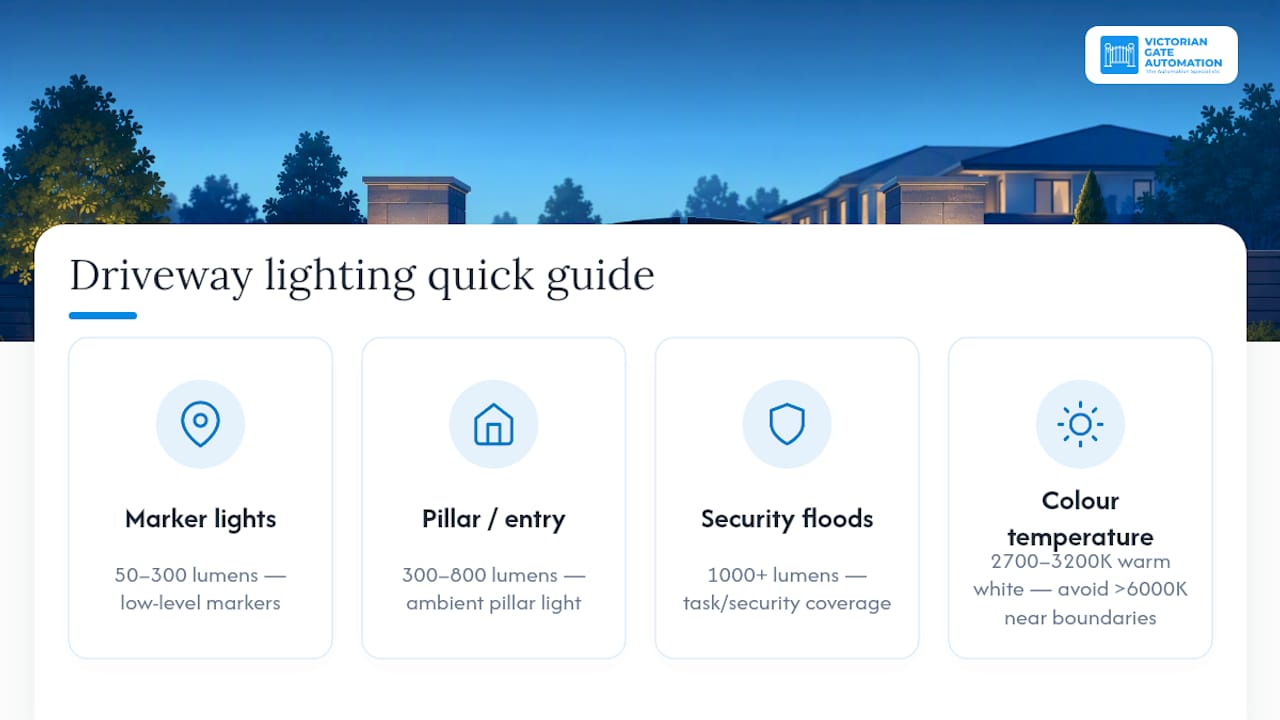
Warm white in a range around 2700 to 3200K reads as welcoming and suits most residential entrances, while higher kelvin settings suit high-contrast security zones but can look harsh, even hostile, if aimed anywhere near a neighbour's fence line. Avoid pushing past 6000K in shared boundary areas.
On brightness, low-level marker lights generally sit at 50 to 300 lumens, pillar or entry lights at 300 to 800 lumens, and security floods at 1000 lumens or more depending on how much ground they need to cover. Modern entrance lighting trends favour efficient LEDs with attention paid to kelvin and colour rendering, which matters if you want your house numbers and stonework to look their actual colour at night rather than washed out.
For materials, stainless steel or powder-coated aluminium rated IP65 or higher handles exposed sites well, and a marine-grade finish is worth the extra cost in coastal locations. In areas prone to knocks or vandalism, check the IK rating too. Layer ambient pillar or bollard light with targeted task lighting rather than betting everything on one bright flood.
How do motion sensors and glare control improve safety?
Motion-sensor LED floods save power and alert you the moment someone approaches, but set the timer and sensitivity properly or you'll get false triggers from passing cats and windblown branches every other night.
On busy sites, high-visibility red and green gate status indicators cut down on the awkward moment where a driver isn't sure if the gate has finished opening. Glare control comes down to three things: shielded fixtures, downward aiming, and correct mounting height, all of which stop light spilling into the road or a neighbour's window. Check beam angle and IP or IK rating against your site's actual traffic and weather exposure before locking in a fixture. Driveway lighting exists to do both jobs at once, boosting street appeal while marking property edges for emergency crews trying to find the right house at 2am.
Do illuminated address numbers actually help?
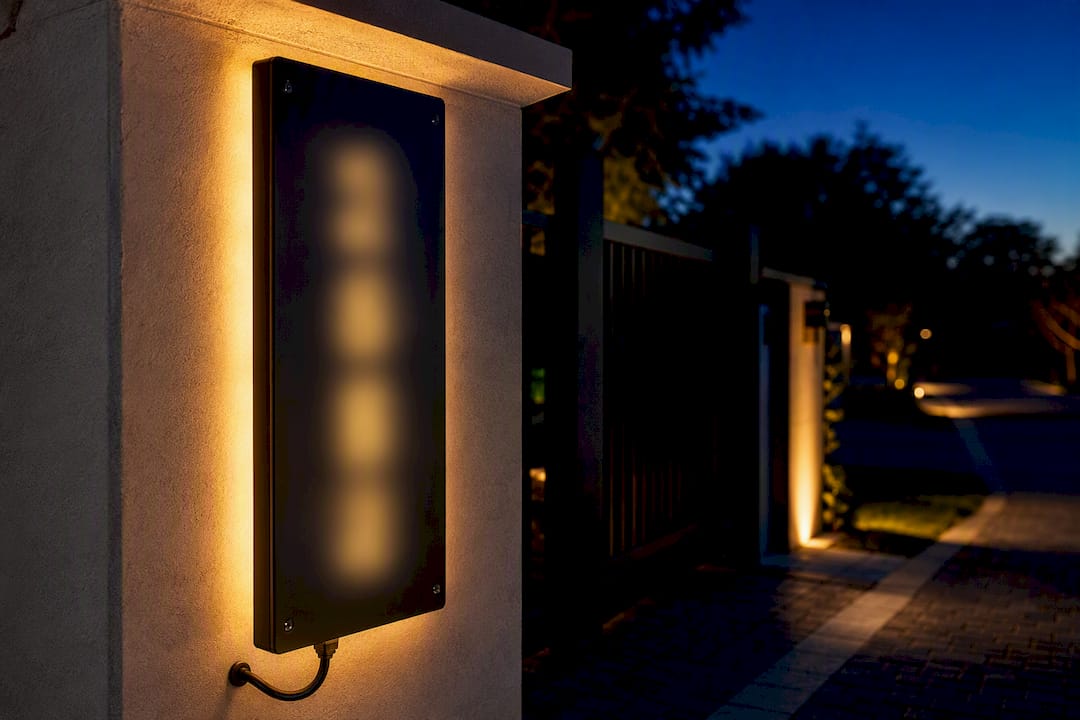
Backlit numbers make a genuine difference for couriers, guests and emergency services trying to find your property in the dark. Warm 2700K LEDs are the common choice because they stay visible without looking clinical.
Most hardwired illuminated numbers need a low-voltage driver, so it pays to plan the sign's position near an existing power source rather than fighting the cable route afterwards. Solar-lit and reflective numbers are cheaper and easier to fit, but walk out to the street after dark and check they're actually legible from a car before you commit. Hardwired units should go to a qualified electrician, and it's worth planning driver access and weather sealing at the design stage rather than as an afterthought.
What should you check before buying driveway lights?
Before you request quotes, work out your site basics: where mains power already runs, how exposed the area is to weather, what you're mounting into, and how long the driveway actually is.
Specs worth asking every supplier for:
- IP rating matched to the site's exposure
- Lumen output and kelvin for each fixture type
- Battery capacity for any solar units
- Warranty length and driver type for hardwired or backlit products
When it comes to installers, ask about their electrical licence, their plan for cable runs, what's covered under installation warranty, and what ongoing maintenance looks like. Professional product ranges typically publish IP55 to IP67 ratings alongside battery and lumen specs precisely so buyers can compare properly, and a supplier who can't produce that information on request is a red flag. So is a low IP rating pitched for an exposed coastal site, or a warranty that's vague about what it actually covers.
What an installer sees on-site that homeowners often miss
Lighting bolted on after the gate is built almost always ends up costlier than lighting planned alongside it. Most clients we work with end up preferring durable finishes and hardwired low-voltage drivers over solar once they see the long-term reliability difference, and a proper site quote with an electrician's check catches problems no product page ever will.
— Rhys
Get driveway gate lighting designed and installed properly
There are options beyond piecing lighting together from separate retailers and tradespeople. Some providers design and fabricate gates handcrafted using quality materials, building lighting and access control into the same process rather than treating it as an add-on fitted after the fact.

Our automation and access control service covers integrating sensor floods and gate status lighting with your motor system, and our illuminated address signs give you a backlit number designed to match your gate and pillar finish rather than looking bolted on. If you're planning a new entrance or upgrading an existing one, our residential gates and fencing team can walk the site with you. A site visit and an electrician's review determine the final price, so request a design consult and we'll scope it properly before anything's quoted.
Sources
Fixture specs and placement guidance in this piece drew on SunnyBunny's solar pillar light range, Modern Lights' illuminated numbers, and design principles from Divine Prints' lighting guide on kelvin and beam control.
- Modern solar gate pillar light — SunnyBunny
- Illuminated address numbers — Modern Lights
- The ultimate guide to driveway lighting — ZY Lighting
- What are the rules for residential lighting in Australia — ParrotUncle
FAQ
How do you light up a driveway entrance?
Combine pillar or bollard markers along the edges with a sensor flood aimed at the vehicle approach, then finish with a backlit address number. This layered approach covers style, safety and wayfinding rather than relying on one fixture to do everything.
Are driveway lights legal in Australia?
Yes, driveway and gate lighting is legal, but fixtures need to avoid glare that could distract passing drivers and should respect neighbouring properties. Hardwired installations must meet local electrical standards, which is why a licensed electrician should handle any mains-voltage work.
What is the best security light for a driveway?
A motion-sensor LED flood mounted high with a shielded beam is generally the strongest option, since it lights the full approach only when needed and avoids constant glare or wasted power. Pairing it with a gate status indicator adds a further layer of safety in busier driveways.
What is the best type of outdoor lighting for a driveway?
There's no single best fixture. A layered mix of pillar or bollard lights for the entrance, inground or spike lights along the edges, and a sensor flood for security covers curb appeal and safety together. Choose solar where cabling is impractical and hardwired where you want dimming or integration with gate automation, and Vicgates can advise on the right combination during a site visit.
Do illuminated address numbers need an electrician?
Hardwired backlit numbers typically need a low-voltage driver and should be installed by a qualified electrician to keep wiring safe and weatherproof. Solar-lit numbers avoid this requirement but should be checked for street visibility after dark before you commit to one.