
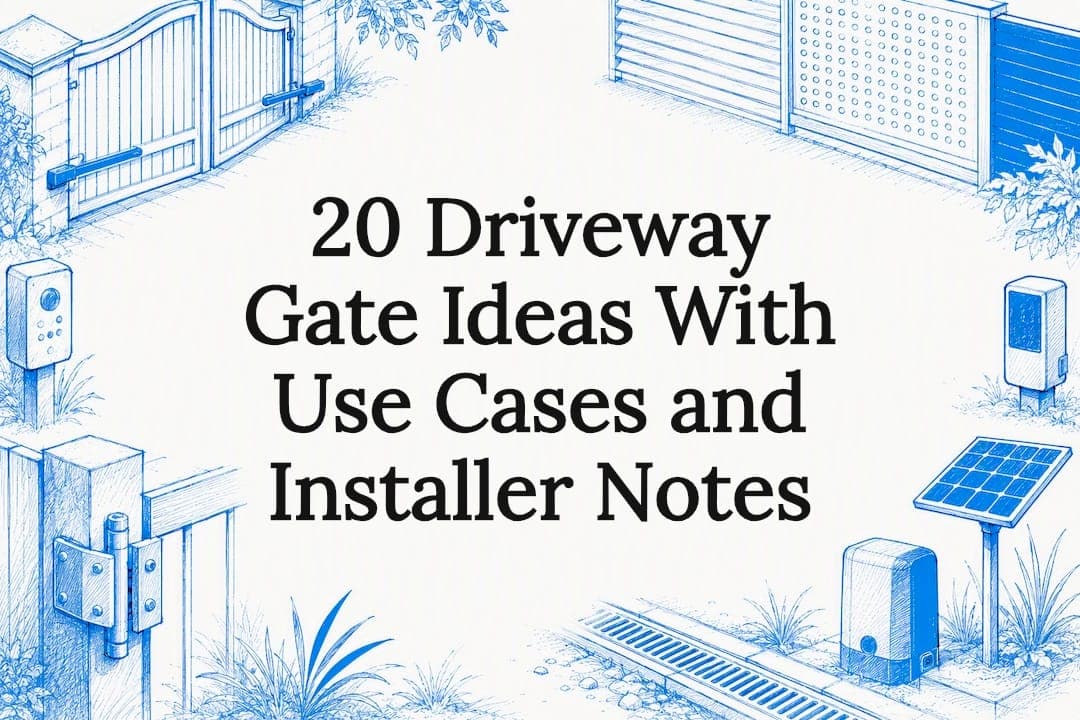
For privacy, a timber or slatted aluminium swing gate wins. For a modern street presence, horizontal-slat aluminium sliding gates dominate current design trends. For a tight or sloped driveway, vertical pivot or bi-fold gates beat ground-track sliders. For security-first properties, steel or wrought iron paired with automation and access control does the heaviest lifting. Slope, surface, and budget will overrule style every time, so check those before you fall in love with a look.
TL;DR:
- Timber gates require sealing every one to three years, while aluminum gates can last longer with minimal upkeep due to their corrosion resistance.
- Automated gates are cost-effective only if opening multiple times daily, with different motor types needed for swing, sliding, or cantilever systems.
- Driveway measurements, slope, and surface type determine the best gate style, with cantilever and pivot gates favored on uneven or sloped driveways.
- Privacy designs with slatted or perforated panels balance airflow and light while maintaining visual screening, especially with adjustable slat gaps.
- Using sustainable materials and solar-powered openers can reduce environmental impact and improve off-grid functionality for rural or long-driveway properties.
Table of Contents
- 20 driveway gate ideas worth stealing
- Materials and finishes: what actually holds up
- Automation, access control, and smart features
- Measurements, slope, surface, and cost: the practical checklist
- What a gate installer actually checks on site
- Privacy and slatted gate designs
- Installation and maintenance basics: posts, drainage, and hardware
- Environmental and sustainability considerations
- Author perspective: what actually delivers long-term satisfaction
- Ready to move from idea to installed gate?
- Sources
- FAQ
20 driveway gate ideas worth stealing
Some of these are true statement pieces. Others are quiet workhorses that just need to open and close for the next 20 years without fuss. Both have their place.
- Horizontal-slat aluminium sliding gate — the current benchmark for a modern driveway gate look; low maintenance, suits wide flat driveways.
- Timber privacy double-swing gate — full board-on-board timber blocks sightlines completely; needs resealing every one to three years to stop warping.
- Wrought-iron scrollwork gate — classic, heavy, and built to outlast most fencing around it; needs a repaint or powder-coat refresh periodically every several years.
- Laser-cut steel panel gate — custom patterns (ferns, geometric grids, house numbers) turn a functional gate into a design feature.
- Frosted-glass panels in an aluminium frame — filters light while blocking eye-level views; wipe clean, no sealing required.
- Corten-steel pivot gate — the rusted patina is intentional and self-stabilising after the first year; ideal for industrial or rural aesthetics.
- Mixed stone columns with a metal leaf gate — pairs masonry weight with a lighter infill; columns need proper footings before the gate ever goes up.
- Bamboo-composite slatted gate — a warm timber look without the sealing schedule; suits coastal or humid climates.
- Cantilever gate for steep driveways — no ground track means no clogging on a grade; the standard fix where slope rules out sliders.
- Vertical pivot gate for narrow sites — swings on a single point rather than a full arc, making it one of the better narrow driveway gate solutions going.
- Folding bi-fold gate — halves the swing space of a standard swing gate, another strong option for a compact gate design brief.
- Telescopic multi-panel slider — panels nest behind each other, useful where you need a wide opening but have limited side clearance.
- Living-wall gate with integrated planters — softens a solid gate with greenery; needs an irrigation plan or it becomes a maintenance headache.
- LED-lit glass-infused panel gate — lighting embedded in the panel itself rather than bolted on afterwards; a genuine after-dark curb-appeal upgrade.
- Carriage-house board-and-batten gate — timber styling that echoes classic barn doors; suits period and farmhouse-style homes.
- Acoustic-core privacy gate — a dense composite core dampens road noise as well as blocking sightlines; worth it on busy corner blocks.
- Integrated parcel locker gate — a built-in locked compartment beside the pedestrian entry solves the "parcel left on the driveway" problem.
- Minimalist steel-plate pivot gate — a single flat plane of steel, powder-coated; almost no moving parts to maintain besides the pivot bearing.
- Reclaimed barn-wood rustic gate — genuinely low-maintenance once sealed, since aged timber has already done most of its moving and cracking.
- Solar-powered automatic opener combo — pairs any of the above with an off-grid opener, useful on rural or long-driveway properties without easy mains access.
Materials and finishes: what actually holds up
Timber gives you warmth and the widest range of driveway gate styles, but it needs sealing every one to three years and hardware rated for outdoor exposure or the hinges will sag before the timber does.
Aluminium is the practical middle ground: light enough for smooth automation, resistant to corrosion, and it holds a powder-coat finish for years with barely any upkeep. Steel and wrought iron are the strength option, built for security-first briefs, but expect a repaint or powder-coat refresh on a five-to-eight-year cycle unless it's hot-dip galvanised first. Composite and vinyl suit wet or coastal climates where timber rot and steel corrosion are constant threats. They will never need sealing, but they also won't take a hand-forged scrollwork pattern.
- Timber: warm, customisable, needs sealing every 1 to 3 years
- Aluminium: light, corrosion-resistant, ideal for automation
- Steel/wrought iron: strongest, heaviest, needs periodic repainting
- Composite/vinyl: near-zero maintenance, limited design flexibility
Pro Tip: Match your gate's finish to your fencing before you match it to your front door. A gate that clashes with the fence line either side reads as an afterthought, no matter how good the gate itself looks.
Automation, access control, and smart features
Automation earns its keep on gates used several times a day or on properties where security matters more than convenience. If you're opening the gate twice a week, manual might be enough. If it's twice daily with kids, tradies, or deliveries in the mix, an opener pays for itself in avoided hassle fast.
Swing gates need a different motor to sliding gates, and cantilever systems need their own dedicated drive. Solar-powered openers with battery backup are increasingly viable for remote or off-grid properties, cutting out expensive trenching for mains power. Whatever the power source, safety hardware isn't optional: photo beams and force-sensing edges that reverse the gate on contact are standard on any compliant install, alongside a manual release for power outages.
- Swing and sliding gates need different motor types; cantilever gates need dedicated drive systems
- Solar with battery backup suits off-grid or long-driveway sites
- Photo beams and auto-reverse edges are safety essentials, not extras
- App control, intercoms, and keypads add convenience but each is one more thing that can fail, so weigh reliability against features
Explore the automation and access control options available before locking in a gate design, since some styles suit certain opener types far better than others.
Measurements, slope, surface, and cost: the practical checklist
Style ideas are only useful once the site constraints are settled. Work through these in order:
- Measure the opening width and, for swing gates, confirm you have clear space for the full arc; sliding gates need track length roughly equal to the opening plus overlap.
- Check the driveway surface. Concrete and compacted asphalt support ground-track sliders well; loose gravel does not, since debris jams the track over time.
- Assess the slope. On a graded or uneven driveway, a cantilever or pivot gate typically outperforms a track slider, which needs a level running surface to work properly.
- Confirm footing depth, drainage, and any underground utilities before excavation starts.
- Budget and schedule realistically: a manual gate costs less upfront, while automatic openers typically add $1,500 to $4,000 depending on gate size and site complexity.
These figures are guide brackets, not quotes. Every site has its own variables, from soil type to how far power needs to run.
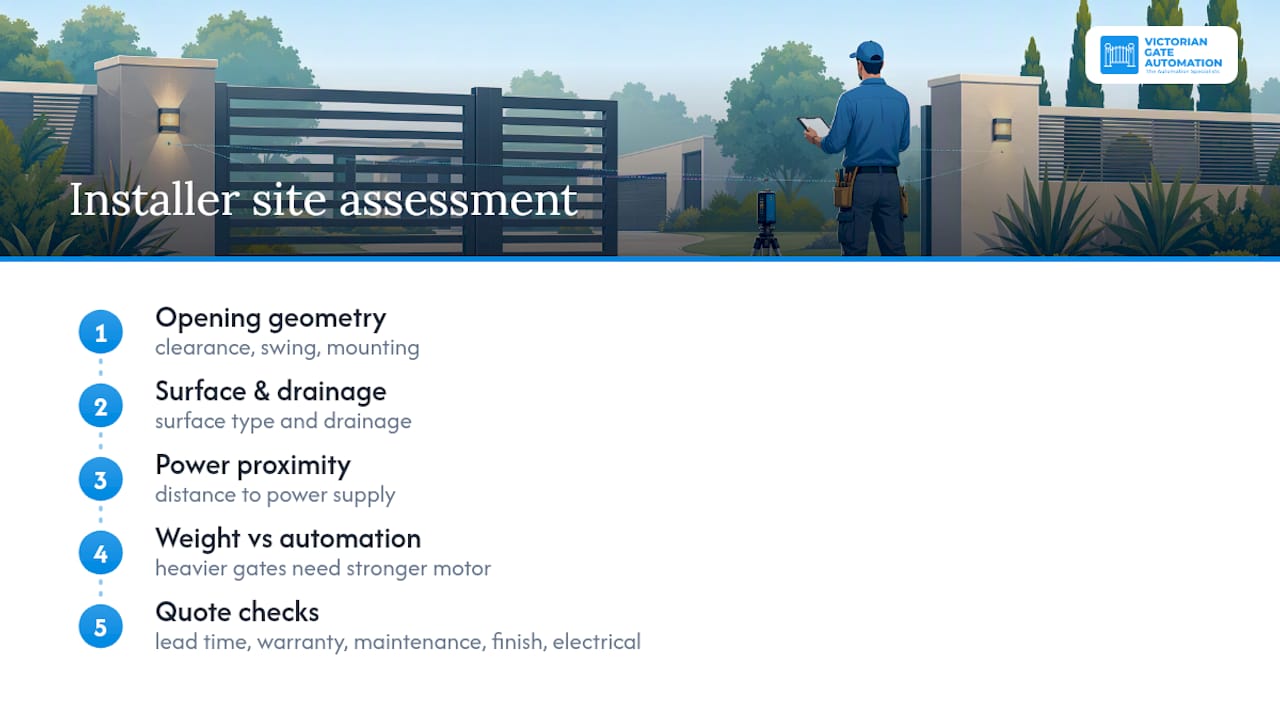
What a gate installer actually checks on site
Ask a fabricator to walk your driveway before you settle on a look. What professionals check first: opening geometry, surface type, drainage, and proximity to power. Weight versus automation is a common trade-off. Heavier timber or wrought iron looks great but demands a stronger motor and sturdier posts. Ask about lead time, warranty terms, the maintenance plan, exact finish specification, and whether electrical work is included in the quote or billed separately.
Privacy and slatted gate designs
Full privacy doesn't have to mean a solid, imposing wall of timber or steel. Slatted profiles, perforated panels, and vertical batten patterns block eye-level views from the street while still letting light and air through, which keeps a gate from feeling like a fortress wall.
Horizontal slats read as contemporary and pair naturally with aluminium or Corten steel. Vertical battens lean more traditional and suit timber or timber-look composite. The gap width between slats is the real design lever here: tighter spacing gives near-total privacy, while wider gaps let more light through and reduce wind load on the gate itself, which matters if you're on an exposed or windy block.
Perforated metal panels, laser-cut into a pattern rather than solid slats, achieve a similar privacy effect with a different visual texture entirely, often incorporating house numbers or a repeating motif that turns the gate into a design signature. Adding integrated lighting along the slats or panel edges extends the effect after dark, turning a purely functional privacy screen into a feature that reads well morning and night.
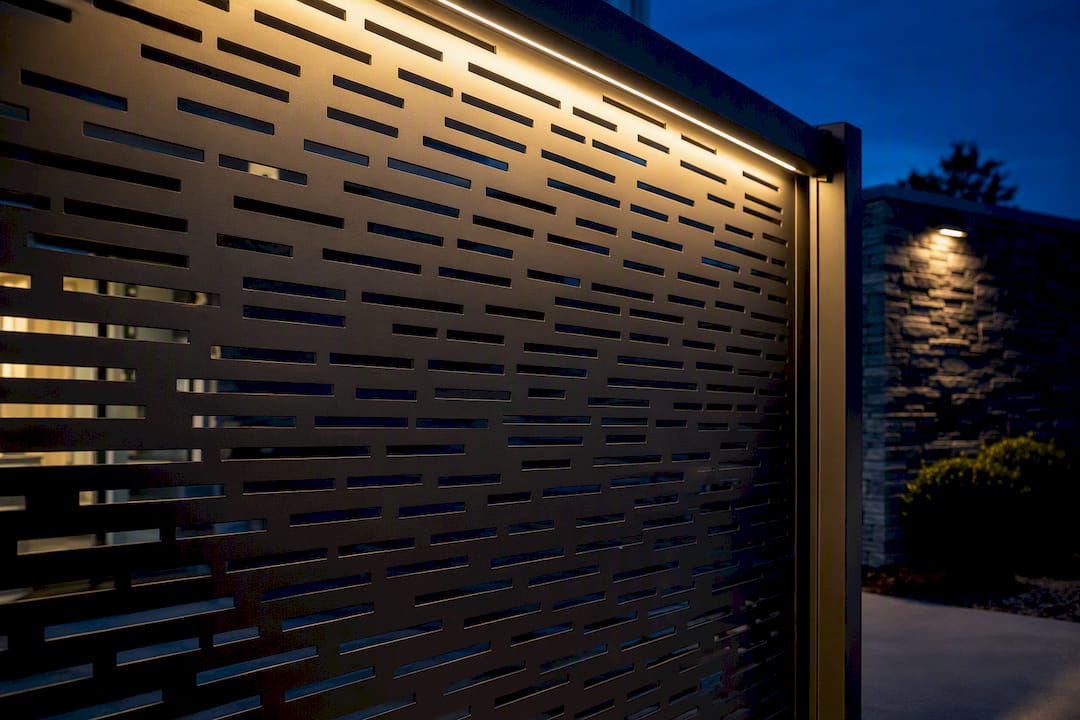
The trade-off is airflow versus opacity. A fully solid gate blocks wind as well as sightlines, which can create a pressure point in exposed locations. Slatted and perforated designs solve that problem while still delivering most of the privacy a solid gate would.
Installation and maintenance basics: posts, drainage, and hardware
Everything above the ground depends on what happens below it. Installers prioritise post foundations and drainage above almost everything else, because properly set piers prevent the sag and lean that eventually fails a gate, while poor drainage around the base accelerates timber rot and steel corrosion long before the gate's expected lifespan is up.
Post footings need to be sized for the gate's weight and the leverage a swing arc puts on the hinge-side post specifically, which carries far more load than the latch-side post. Concrete footings should sit below the frost or movement line for your soil type, and the ground around the post needs a fall away from the base so water doesn't pool against it.
Hardware matters as much as the posts. Hinges, latches, and hinge pins should be rated for outdoor use and, ideally, stainless steel or hot-dip galvanised rather than standard zinc-plated fittings, which corrode faster in coastal or high-rainfall areas. A basic maintenance routine covers three things: check and lubricate moving hardware every six months, inspect timber seals annually, and clear debris from any ground track before it builds up enough to jam the mechanism.
Environmental and sustainability considerations
Material choice has a real environmental footprint, and it's worth weighing alongside looks and budget. Timber sourced responsibly is a renewable material with a lower manufacturing footprint than steel or aluminium, though it needs more frequent maintenance products (sealants, oils) over its lifetime. Aluminium and steel both carry a heavier upfront manufacturing footprint but last decades with minimal replacement, and both are highly recyclable at end of life, which offsets some of that initial cost.
Composite materials, often made from recycled plastics and wood fibre, divert waste from landfill but are harder to recycle again once their service life ends. Corten steel needs no paint or coating at all, since its patina is the finish, which removes an entire category of maintenance chemicals from the equation over the gate's life.
On the energy side, solar-powered gate openers are the standout option for reducing ongoing energy use, particularly on rural properties where running mains power to a gate motor means trenching a long cable run. Pairing solar with a battery bank also means the gate keeps working during a blackout, which a mains-only system can't offer. If sustainability is a genuine priority rather than a box to tick, ask your fabricator about local material sourcing too. Shorter supply chains for timber and steel cut transport emissions before the gate even reaches your driveway.
Author perspective: what actually delivers long-term satisfaction
Durability and appropriate automation beat pure style almost every time. The homeowners happiest with their gate five years on chose materials suited to their climate and automation matched to actual daily use, not the flashiest option in the showroom. The rule of thumb: solve the site problems first, slope, surface, exposure, then choose the look. A gorgeous gate fighting its own driveway will always lose.
— Rhys
Ready to move from idea to installed gate?
A specialist gate fabricator is the option for readers who want a gate built for their exact driveway rather than adapted from a catalogue. The process typically starts with a site survey to check your opening, surface, slope, and power access, the same checklist covered above, followed by a custom design and a fabrication and installation quote.
Whether you're after a residential gate built for kerb appeal, a commercial access solution, or want to explore automation and access control for an existing gate, get in touch for a site survey and a quote tailored to your driveway, not a generic template.
Sources
- Driveway Gate Ideas: Styles, Materials, and Installation for Every Home
- Best Gates for Tight Spaces and Small Driveways
- Top 6 Trendy Driveway Gate Ideas that You'll Love
FAQ
What are some affordable driveway gate ideas?
A simple timber picket swing gate or a single flat steel-plate pivot gate are among the cheapest options to build well, since both use minimal material and hardware compared with double-swing or slatted designs.
What is a good simple gate for a driveway?
A single-swing gate in timber or aluminium with basic hinge-and-latch hardware is the simplest reliable option. It has the fewest moving parts and suits most standard driveway widths.
What are the cheapest driveway gates?
Manual gates cost less than automated ones from the outset, and adding an automatic opener typically adds $1,500 to $4,000 depending on gate size and site complexity, so skipping automation is the biggest single saving.
How do I build my own driveway gate?
Building your own gate means sourcing a frame material, setting posts on properly sized footings with good drainage, and installing rated outdoor hinges and a latch. For anything involving automation, safety sensors, or a heavy gate, getting a professional survey first avoids costly rework.
Should I choose a sliding or swing gate?
Swing gates suit driveways with clear space for the arc and flat, solid surfaces. Sliding gates work well on wide, level concrete or asphalt driveways, but ground-track sliders struggle on gravel or sloped sites, where a cantilever or pivot gate is the more reliable choice.