
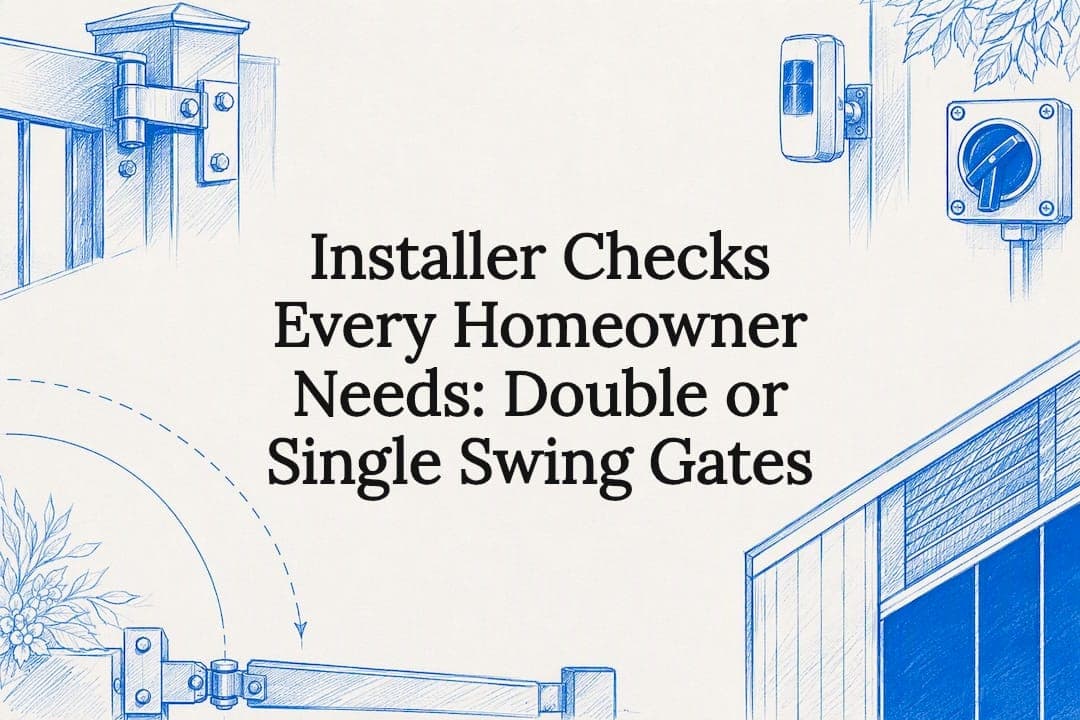
A single-leaf swing gate usually suits narrower openings and tighter budgets, while a double-leaf gate suits wider or heavier entrances where one panel would be too large to swing or hang safely. The right pick depends on swing radius, leaf weight and how the gate will be automated. Before you commit either way, check that the gate moves freely by hand and that the posts can carry the load, because no motor fixes a structural shortfall.
TL;DR:
- A single-leaf gate is suitable for narrow openings and costs less to install, but it requires more clearance on one side and may limit parking.
- Double-leaf gates are better for wider or heavier entrances, as they distribute the load and reduce swing radius, but they involve higher upfront costs and more complex installation.
- Ensuring the gate moves freely by hand and that posts can support the weight are crucial steps before considering automation, since structural issues cannot be fixed by motors.
- Safety devices such as photoelectric sensors and safety edges must be installed and tested to meet safety standards, regardless of gate type.
- Proper site assessment, including checking ground level, swing space, and wind exposure, is necessary to choose the right configuration and avoid costly modifications later.
Table of Contents
- How single leaf and double leaf gates differ in practice
- Site and structural checks an installer will use to decide
- What automation changes and the safety standards to expect
- Supply, installation and ongoing costs: what drives price and timing
- Practical recommendation and immediate next steps
- What experienced fabricators check before they quote
- How Victorian Gate Automation can help with your gate project
- Selected authoritative standards and manuals
- Sources
- FAQ
How single leaf and double leaf gates differ in practice
A single-leaf gate is one panel that spans the full opening and swings on one side. A double-leaf gate splits that same opening into two panels that meet in the middle, each hinged to its own post. The practical difference shows up the moment you measure the swing radius: a single leaf across a wide opening needs a generous arc of clear space to open fully, while splitting that width in two roughly halves the depth each panel needs to swing.
Leaf weight matters just as much as width. A single panel spanning a wide driveway concentrates all that mass on one set of hinges and one post, which increases sag over time and puts more strain on the hinge pins. Splitting the same opening into two leaves spreads the load across two posts, which is one reason fabricators lean towards double leaves once spans get wider or the chosen material (solid timber, heavy wrought iron) adds significant mass.
Beyond the mechanics, the choice affects everyday use:
- A single leaf clears the driveway on one side only, which can limit where you park if the swing arc overlaps a parking bay.
- A double leaf opens outward or inward in two smaller arcs, often leaving more usable space close to the gate line.
- Pedestrian access is easier with a double leaf, since one panel can open on its own without moving the full span.
- A single leaf generally costs less to fabricate and install, with one motor, one set of hinges and simpler wiring.
- A double leaf tends to suit wider or more decorative entrances, such as those built with custom wrought iron, where symmetry matters as much as function.
Neither option is universally better. It comes down to the opening width, the weight of the gate you want, and how much swing space the site actually has.
Site and structural checks an installer will use to decide
Before anyone talks motors, an installer needs to confirm the gate will work as a manual gate first. Automation only ever adds to what is already there, it never corrects a structural problem underneath it.
- Test manual free movement by swinging the gate fully open and closed by hand: any binding, dragging or resistance needs fixing before automation goes anywhere near it.
- Check post and hinge specifications against the gate's weight and span, since undersized posts lead to sag, misalignment and premature hinge wear.
- Assess slope and ground level across the swing path, because uneven ground may call for rising hinges or a revised swing direction.
- Consider wind loading on the leaf area, particularly for solid infill panels, since higher exposure sites can justify a double leaf or reinforced hardware even on a moderate span.
Installation manuals for swing gate operators are consistent on this point: the supporting structure must be sufficiently rigid and the gate must move freely by hand before an operator is fitted, with leaves over certain widths sometimes needing additional locking hardware to stay secure when closed.
Pro Tip: Walk the full swing arc yourself before ordering anything: if a tree, step or slope interrupts it, that constraint should decide the leaf configuration, not the other way around.
What automation changes and the safety standards to expect
Automating a double-leaf gate is a different job to automating a single leaf. Two panels generally need two drive units or a synchronised control system so both leaves open and close together without one leading or trailing the other. Most systems also support a pedestrian mode, opening one leaf only for foot traffic while the other stays shut, a feature dual-leaf operator manuals build in as standard.
Matching operator rating to leaf weight and wind exposure matters more than raw motor power. A stronger motor cannot compensate for a poorly braced post or a gate that already binds when moved by hand, it will simply strain harder against the same fault.
Safety devices are not optional extras. A properly commissioned installation includes photoelectric cells, safety edges on the leading edge, an isolation switch, and documented testing of every safety feature at handover, in line with automatic gate safety guidance covering hazard areas around powered gates.

One of the clearest points in that guidance is that maintenance should include testing of safety devices and opening or closing forces, not just a visual check, since a device that looks fine can still fail under load.
Supply, installation and ongoing costs: what drives price and timing
A gate project moves through a fairly predictable sequence, and each stage affects both cost and how long the job takes.
- Site assessment, where an installer measures the opening, checks ground conditions and confirms swing space.
- Fabrication, where the gate is built to the confirmed span, material and finish.
- Site rectification if needed, such as new posts, footings or levelling uneven ground.
- Electrical work to run power to the motor and any access control hardware.
- Installation and commissioning, including fitting the operator, testing safety devices and demonstrating manual release.
Cost is driven mainly by gate material and span, the type of motor and safety devices specified, and how much site preparation or post remediation the ground needs before the gate goes in. A wider double-leaf gate with dual drives and full safety hardware will always cost more to supply and commission than a single leaf on a straightforward site, but skimping on posts or safety devices to save money tends to cost more later in repairs. When you're setting a budget, spend first on structure and safety hardware, since those are the parts that are expensive and disruptive to fix once the gate is in.
Practical recommendation and immediate next steps
For a narrow opening or a tight budget, a single leaf is usually the simpler, more economical choice. For a wide opening, a heavy gate, or a site where swing space is limited on one side, a double leaf spreads the weight and the arc more sensibly. Aesthetic preferences, such as matching double leaves on either side of a grand entrance, can also tip the decision.
Before finalising anything, ask an installer three things: does the gate move freely by hand, are the posts rated for the finished weight, and how much clear swing space does the site actually allow? A custom, professionally installed gate is worth it whenever the opening is wide, the material is heavy, or the site has slope, wind exposure or tight clearances to work around.

What experienced fabricators check before they quote
Fabricators who have handled driveway gates for years tend to look past the leaf count first. They check whether the posts already in the ground can take the finished weight, whether the swing arc actually clears everything it needs to, and whether the automation being asked for matches what the structure can support. Aesthetics matter, but they come after the gate is confirmed to move safely and hold up over years of daily use.
A specialist gate company has built custom automatic gates, fencing and access control systems for many years, working from design through to installation with Australian-made, locally sourced materials.
— Rhys
How Victorian Gate Automation can help with your gate project
Choosing between a single leaf and a double leaf is easier once someone has actually stood at your driveway and measured the swing space, the slope and the load. That's what a design consult is for: a fabricator walks the site, confirms what the posts and ground can support, and recommends the leaf configuration and automation that fit, rather than the one that's easiest to sell.
The company designs and hand-fabricates custom gates using Australian-made materials, then handles installation, automation and commissioning as one project rather than handing you between contractors. If you're weighing up a wider double-leaf entrance with decorative ironwork, explore custom wrought-iron gate options and request a design consult to get a plan built around your site rather than a generic template.
Selected authoritative standards and manuals
- BFT automatic gate safety guidelines cover hazard areas, required safety devices and commissioning checks for powered swing gates.
- SMDoors automatic door and gate safety guidance outlines additional control measures needed where children, elderly users or frequent operation increase risk.
- GDS4 LVE swing gate operator manual sets out structural rigidity, manual release and motor selection requirements before automation.
- AS 3996:2019 Access covers and grates is relevant when assessing load-bearing materials and components for durable gate installations.
Sources
- Guide to automatic gate safety (BFT Australia & New Zealand safety guidelines)
- Automatic doors and gate safety guidance (SMDoors excerpt)
- GDS4 LVE swing gate operator installation and maintenance manual (AGAD / operator manual)
- AS 3996:2019 Access covers and grates — Standards Australia
FAQ
Is a double swing gate stronger than a single swing gate?
Not automatically. Strength comes from post and hinge specification matched to the gate's weight and span, and a well-built single leaf on a suitable opening can be just as durable as a double leaf. Splitting a wide, heavy gate into two leaves does reduce the load on any one post, which is why dual-leaf operator manuals are common on wider driveways.
Do double leaf gates need two motors?
Most dual-leaf gates use two drive units or a synchronised control system so both panels open and close together, and many support a pedestrian mode that opens just one leaf. A single-leaf gate needs only one operator, which keeps wiring and commissioning simpler.
What safety devices are required on a powered swing gate?
Expect photoelectric cells, a safety edge on the leading edge of the gate, and an isolation switch, with all of it tested at commissioning under automatic gate safety guidelines. An installer should also demonstrate manual release and isolation points at handover.
How do I know if my gate needs structural work before automation?
Swing the gate fully open and closed by hand: any binding, dragging or resistance signals a problem that needs fixing before an operator goes on. Operator manuals are explicit that the gate must move freely and the structure must be rigid before automation, since a stronger motor will not fix a weak post.
Does the company install both single and double swing gates?
Yes, they design and hand-fabricate both single-leaf and double-leaf swing gates, along with the automation and access control systems to run them. You can start with a design consult through the wrought-iron gate service to work out which configuration suits your site.