
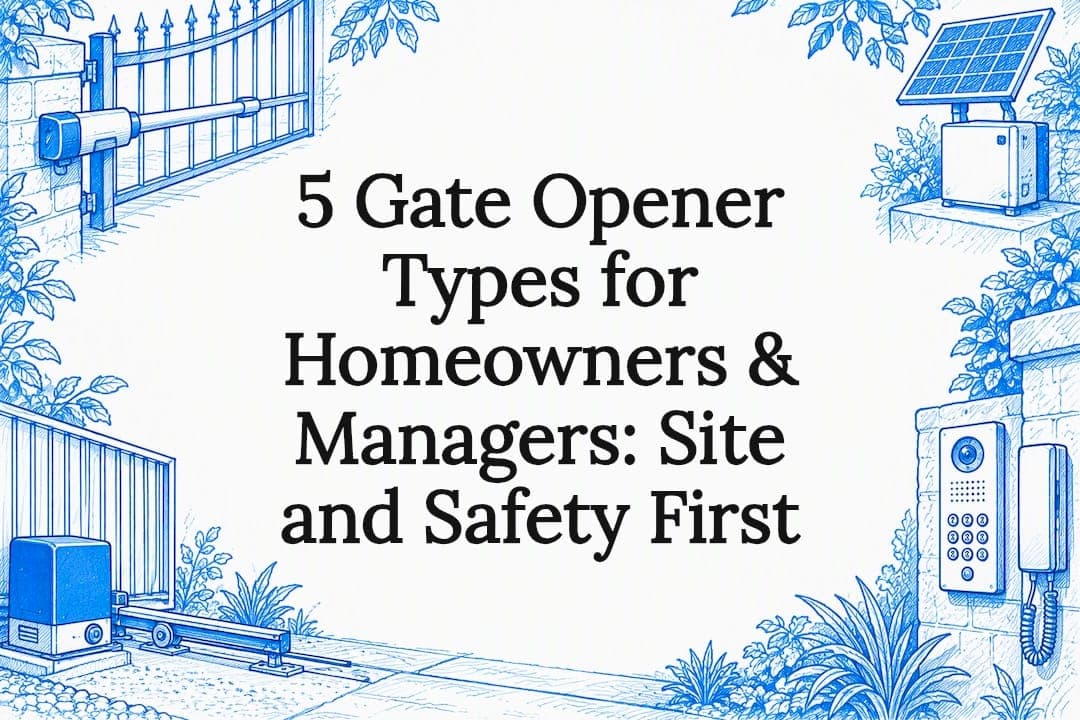
For narrow driveways, a sliding opener makes the most sense; for uneven or waterlogged ground, cantilever sliding avoids the drainage problems a track-mounted gate would hit; and where you want a tidy look with no visible arm, underground swing operators are worth considering if your site allows for the buried housing. The right choice always comes down to your gate's weight, your site's slope and side room, and how often the gate needs to open.
TL;DR:
- Narrow driveways are best served by sliding or cantilever sliding systems, especially on uneven or waterlogged ground, to avoid drainage issues.
- Swing gate operators include articulated arm, linear, and underground types, each with specific site suitability based on space, gate weight, and aesthetic preferences.
- Regular maintenance, duty cycle matching, and verified manual-release testing are more critical to reliability and safety than brand or smart features.
- Ground conditions, gate weight, traffic frequency, and site measurements should guide the selection of motor type and power backup system, especially in rural or coastal areas.
- Proper installation and ongoing safety inspections, including safety sensors and lock features, are essential to prevent accidents and ensure the gate operates consistently over time.
Table of Contents
- Main gate opener categories at a glance
- Swing gate openers: arm, linear and underground systems
- Sliding gate openers: track mounted and cantilever systems
- Other gate types worth knowing about
- How to choose: a site and spec checklist before you buy
- Installation, maintenance and safety essentials
- What a professional installation should look like
- Power sources and backup options
- Control and access methods
- Security features worth insisting on
- Noise levels and how fast each type operates
- Does it work with your smart home setup?
- What I'd prioritise over everything else
- Why Vicgates is worth a conversation
- Sources
- FAQ
Main gate opener categories at a glance
Most properties end up choosing from five broad categories: swing, sliding, vertical lift, bi-fold and barrier or boom. Each suits a different mix of space, traffic and gate weight.
- Swing gates pivot on hinges like a door and suit properties with enough driveway depth for the leaf to clear when open.
- Sliding gates run parallel to a fence line and suit narrow driveways or sloped entries where a swinging arc would not clear.
- Vertical lift gates rise straight up and suit sites with no side room for sliding and no depth for swinging, often industrial yards.
- Bi-fold gates fold in half as they open, needing roughly half the clearance of a single swing leaf for the same opening width.
- Barrier or boom gates are arm-style vehicle controls, suited to car parks and toll points rather than full perimeter security.
A quick sweep of your site, measuring driveway width, slope and the clear space on either side of the gate, will usually eliminate two or three of these before you even talk to an installer. Steep driveways rule out most sliding systems, and tight side boundaries rule out sliding and bi-fold alike, leaving swing or vertical lift as the practical options.
Swing gate openers: arm, linear and underground systems
Swing gates are driven by one of three mechanical approaches, and the right one depends on leaf weight, available side room and how discreet you want the hardware to look.
- Articulated arm operators use a jointed arm that folds as the gate opens, handling tighter pillar clearances and suiting most residential single or double leaf gates.
- Linear or ram operators push the gate open in a straight line, generally handling heavier leaves and wider opening angles than articulated arms.
- Underground operators sit in a buried housing below the gate, leaving no visible motor or arm, which suits heritage properties or anywhere street appearance matters.
Each subtype places different loads on the gate itself. Articulated arms put most of the stress on the hinge posts, so post footings need to be solid; for more detailed hardware considerations, see our commercial door hardware guide: hinges, closers & locksets. Linear rams distribute force more evenly along the leaf but need a firm mounting point on the pillar. Underground operators are sealed units, so they are less exposed to weather but harder to service, since the housing often has to be excavated or opened to reach the mechanism.
Pro Tip: Check the manufacturer's duty cycle rating against your actual gate use, a motor rated for occasional home use will wear out fast on a property with frequent vehicle movements.
Sliding gate openers: track mounted and cantilever systems
Sliding gates suit narrow driveways and properties where a swinging arc would cross a footpath or encroach on neighbouring land.
- Track-mounted sliding systems run the gate along a ground-level rail, which is cost-effective but vulnerable to grit, leaf litter and debris fouling the track over time.
- Cantilever sliding systems support the gate on rollers mounted to the frame itself, with no ground-level track, so they avoid the drainage and debris problems that plague track-mounted gates on uneven or waterlogged ground.
- Wider or heavier gates need a correspondingly sized motor, and undersizing a motor for a long, heavy leaf is one of the most common causes of premature gate opener failure.
Track-mounted gates are the simpler and usually cheaper option where the ground is stable and well-drained. Cantilever systems cost more upfront because they need a longer internal frame and stronger support posts, but they are the better fit for rural properties, sites with poor drainage or anywhere the ground shifts seasonally.
Other gate types worth knowing about
A handful of less common gate types solve specific space or traffic problems that swing and sliding systems cannot.
- Vertical lift gates suit sites with no side clearance for sliding and insufficient depth for swinging, common on industrial yards with security fencing on both sides.
- Bi-fold gates are a space-saving option for wide openings where full side room for a single sliding leaf is not available.
- Barrier or boom arms control vehicle access at a single point, such as a car park entry or a toll booth, rather than securing a full perimeter.
These options generally involve more specialised installation and higher running costs than standard swing or sliding gates, so they are usually chosen only when site constraints or traffic patterns rule out the simpler alternatives.
How to choose: a site and spec checklist before you buy
Work through your site constraints before looking at motor brochures, since the physical layout narrows the field faster than any spec sheet.
- Measure driveway width, slope and side room on both sides of the opening, since even a small slope can rule out sliding systems.
- Weigh up the gate leaf, because heavier timber or wrought iron gates need a higher-rated motor than lightweight aluminium or tubular steel.
- Match duty cycle to traffic, a home with two or three openings a day has very different needs from a commercial site with constant vehicle movement.
- Check the IP rating for weather exposure, especially on coastal or exposed rural properties.
- Confirm the manual release procedure and ask whether it has been tested, since a gate that cannot be moved safely by hand during a power failure is a real problem, not a minor inconvenience.
Pro Tip: Ask any installer for documented proof of duty cycle testing and a written warranty, a vague answer on either point is a red flag worth walking away from.
Access control needs to matter too. A single-family home might only need a remote and a keypad, while a multi-tenant property or commercial site often needs integration with an existing intercom or access management system, which is worth raising with your installer early rather than retrofitting later.
Installation, maintenance and safety essentials
Industrial gate safety | SafeWork NSW treats automatic gates as plant under health and safety law, which means installation by a competent person and regular maintenance are not optional extras, they are the baseline. The same guidance recommends safety beams, or photo eyes, that stop and reverse the gate automatically if something or someone is in its path.
- Inspect drive mechanisms, stoppers, tracks and safety sensors on a regular schedule, not just when something goes wrong.
- Worn stoppers, broken support posts or guides, and tracks fouled by grit and debris are among the most common failure causes named in industry safety guidance.
- Never operate a gate manually after a drive failure without a prior risk assessment and a safe system of work, as SafeWork NSW advises.
- Insist on photo eyes, anti-collision sensing and travel limiters as standard safety features, along with a clearly documented manual-release procedure.
Maintenance neglect is a major contributor to gate accidents, and an organised inspection and maintenance plan meaningfully reduces that risk, according to SafeWork NSW. Installation costs and ongoing servicing fees generally scale with gate weight, motor size and the complexity of the access control system fitted alongside it.
What a professional installation should look like
Professional installers bring more than a motor and a drill. An experienced gate installation company typically designs, fabricates and installs residential and commercial gates and access-control systems, using an end-to-end process from design consult to installation. A proper quote should include a site survey, a design consultation covering material and finish options, and a clear outline of ongoing maintenance or servicing options, so you know what happens after the gate is fitted, not just what happens on install day.
Power sources and backup options
Most gate openers run on mains electricity, with the motor converting that power into the mechanical movement needed to swing, slide or lift the gate. For properties without easy mains access, solar-powered systems use a panel and battery bank to run the motor independently, a common choice for rural gates well away from the house.

Even mains-powered systems increasingly include a battery backup as standard, so the gate keeps working through a power outage rather than locking residents out or in. This matters more than it sounds: a gate that fails shut during a blackout is a genuine access problem, and a gate that fails open is a security gap. Battery backup bridges that window until mains power returns.
Brushless DC motors are becoming more common in both mains and solar setups because they tend to run more efficiently and quietly than older AC motors, with a longer service life under frequent use. For a residential driveway opened a handful of times a day, a DC system usually offers the better long-term balance of quiet running and efficiency. For a commercial site with constant traffic, duty cycle rating matters more than motor type, since even a good motor will wear out early if it is undersized for the job.
Whichever power source you choose, ask your installer how the backup is tested and how long it is expected to carry the gate through an outage, since specifications vary considerably between brands and battery capacities.
Control and access methods
How you open the gate day to day matters as much as how the gate itself moves. Handheld remote controls remain the most common method, simple to use and familiar to most households, though they do mean managing a small fleet of fobs across a family or tenancy.
Keypads add a shared code entry option for visitors, tradespeople or delivery drivers without issuing a remote, though codes need periodic changing to stay secure. Smartphone app integration has become a standard offering on newer systems, letting you open the gate remotely, grant temporary access to a visitor or check gate status without being on site, which suits property managers juggling multiple tenants or sites.
Intercom integration, whether audio or video, adds a verification step before the gate opens at all, useful for properties where visual confirmation matters more than speed. Many of these methods work together rather than as alternatives: a typical residential setup might pair a remote for the household with a keypad for guests and an app for remote management, while a commercial site often adds intercom and integrates the gate with an existing building access system.

Security features worth insisting on
A gate is only as secure as its weakest control point, and modern openers include several features aimed squarely at that problem. Anti-tamper mechanisms protect the motor housing and control board from physical interference, an important feature for gates installed in less visible locations.
Rolling code encryption on remote signals is now close to standard on reputable systems, replacing older fixed-code remotes that could be copied or intercepted relatively easily. Auto-locking features engage a mechanical lock once the gate reaches its closed position, adding a layer of resistance against forced manual opening that a motor alone does not provide.
When comparing systems, ask specifically about encryption type and whether auto-locking is built in or needs to be added separately, since these details are not always obvious from a brochure and vary meaningfully between entry-level and higher-specification motors.
Noise levels and how fast each type operates
Operational noise and speed vary noticeably between gate types, and both are worth factoring in if the gate sits near a bedroom window or a shared boundary. Swing gates driven by linear or ram operators tend to run quietly, since the mechanism moves in a simple straight push.
Sliding gates, particularly track-mounted systems, can generate more noise from rollers running along the rail, especially if the track has not been cleaned or lubricated recently. Cantilever systems run on enclosed rollers rather than an open track, which often makes them quieter in practice. Underground swing operators are typically the quietest option overall, since the mechanism is sealed below ground and insulated from the open air.
Speed differences matter more for commercial or high-traffic properties, where a slow-opening gate can create a queue at busy times. Barrier and boom arms are built for speed, often opening in a couple of seconds, while heavier sliding and swing gates necessarily move more slowly given the mass they are shifting. Brushless DC motors tend to offer smoother, more consistent speed through the opening cycle compared with older AC-driven systems, which can be worth the difference in daily use.
Does it work with your smart home setup?
Smart home compatibility has shifted from a premium add-on to a near-standard expectation on new gate systems. Most current openers integrate with a smartphone app as a baseline, and many extend that further into existing smart home ecosystems, letting you trigger the gate alongside lighting, cameras or an alarm system from a single app.
This matters most for property managers overseeing several sites, since centralised control and activity logs cut down on the back and forth of managing separate remotes or codes for each property. For a single home, the practical benefit is usually simpler: checking the gate is closed without walking down the driveway, or letting in a visitor remotely while away.
Not every system plays well with every smart home platform, so if integration matters to you, it is worth confirming compatibility with your specific setup before committing to a motor, rather than assuming all brands support the same ecosystem.
What I'd prioritise over everything else
Most gate opener research online obsesses over motor brand and smart features, and both matter less than people think. What actually determines whether a gate works reliably for years is duty cycle matched honestly to real traffic, a manual-release system that has actually been tested rather than assumed to work, and a maintenance routine that someone actually follows.
I'd rather see a reader choose a basic articulated arm operator with a documented service schedule than a premium system nobody checks on. The conventional advice leans hard on comparing features and prices, when the bigger risk sits in installation quality and ongoing upkeep, the parts that do not show up on a spec sheet. If you take one thing from this guide, make it this: ask your installer how the manual release is tested and how often the gate will be serviced, before you ask what app it connects to.
— Rhys
Why Vicgates is worth a conversation
If you have narrowed down the type of gate that suits your site, the next decision is who builds and fits it. Vicgates designs and fabricates gates in-house using locally sourced materials, which means the gate you get is built for your driveway's width, slope and weight requirements rather than adapted from a standard template.

That approach suits homeowners who want a gate that matches the house rather than a catalogue item, and it suits property managers who need a heavier-duty system built to handle daily commercial traffic. Whether you need a straightforward residential gate or a commercial or industrial installation, the process starts the same way: a site visit, a design discussion and a clear quote before anything is fabricated. If you are ready to talk through your site, request a design consult and get a plan specific to your property.
Sources
For installation and safety obligations, see SafeWork NSW's industrial gate safety guidance. For professional automation and access control services, visit Vicgates directly.
- Industrial gate safety | SafeWork NSW
FAQ
What are the different types of gate openers?
The main categories are swing, sliding, vertical lift, bi-fold and barrier or boom gates, each suited to different site widths, slopes and traffic levels. Swing gates use articulated arm, linear or underground operators, while sliding gates split into track-mounted and cantilever systems.
What is the best type of swing gate opener?
Articulated arm operators suit most standard residential gates with reasonable pillar clearance, while linear or ram operators handle heavier or wider leaves better. Underground operators are the choice when you want no visible hardware, though they are harder to service since the mechanism sits below ground.
What are the top automatic gate openers?
There is no single ranked list, since the right opener depends on gate weight, driveway layout and traffic frequency rather than a brand name. Comparing duty cycle, motor type and documented safety testing against your own site is a more reliable approach than chasing a generic top pick.
What is the best automatic gate opener for a home driveway?
For most home driveways, an articulated arm swing operator or a track-mounted sliding system covers typical traffic and site layouts well. The better question is whether the installer has matched the duty cycle to your actual usage and tested the manual release, since that affects reliability more than the motor brand.
How often should a gate opener be serviced?
There is no single universal interval, since it depends on usage and manufacturer specification, but SafeWork NSW treats automatic gates as plant requiring regular maintenance and inspection. A proper service checks the drive mechanism, stoppers, tracks and safety sensors, and includes a manual-release test.