
Timber-look aluminium slats are aluminium profiles finished with a woodgrain coating that mimics the colour and texture of real timber, without the rot, termites, warping, or upkeep. They suit most DIY fencing, screening, and cladding jobs, particularly shorter runs with standard post spacing. For long spans, gate integration, or exposed coastal sites, get a fabricator involved.
TL;DR:
- Most aluminium slats come in 38mm, 65mm, and 100mm widths, with profile depths around 16mm and lengths of 5.8 to 6.5 meters, affecting transport and installation.
- Durability and longevity vary with finish type, with sublimation generally lasting longer than powder coating, and certifications like non-combustibility should be verified through test certificates.
- DIY installation is suitable for standard spans under 6 meters, but longer or more exposed sites require professional fabricators for proper framing, fasteners, and site assessment.
- Choosing the correct post spacing and rail support based on datasheets is critical to avoid misalignment and early failure, especially when integrating gates or spanning large areas.
- Price differences depend on profile width and finish, but aluminium typically offers lower total costs over time due to minimal maintenance and no need for staining or sealing.
Table of Contents
- What sizes and specs do timber look aluminium slats come in?
- Why choose aluminium over real timber for a slat fence?
- How do you install timber look aluminium slats yourself?
- Which slat width and finish suits your project?
- What should you check before buying aluminium slats?
- What fabricators check on-site that DIYers often miss
- What the DIY guides don't tell you
- Get a custom slat fence designed and fitted properly
- Where to check specs and certificates
- Sources
- FAQ
What sizes and specs do timber look aluminium slats come in?
Before you order anything, get familiar with the numbers that actually determine how a job goes together. Slat width is the first decision, and most Australian suppliers stock three standard sizes.
- 38mm — narrow profile, often used for delicate screening or infill panels where you want light and airflow through.
- 65mm — the most common width for fencing and privacy screens, offering a good balance between coverage and material cost.
- 100mm — wide, bold slats used for statement fences, facades, or feature walls where a strong horizontal line matters.
Profile depth typically sits around 16mm, which gives the slat enough rigidity to span between posts without sagging or drumming in the wind. Material thickness usually falls between 1.0mm and 1.2mm, thick enough for structural stability but light enough to cut and handle without specialist gear. Standard lengths run 5.8m to 6.5m, which matters for transport planning. A 6.5m length won't fit in a standard trailer diagonally, so factor that into your pickup or delivery arrangement.
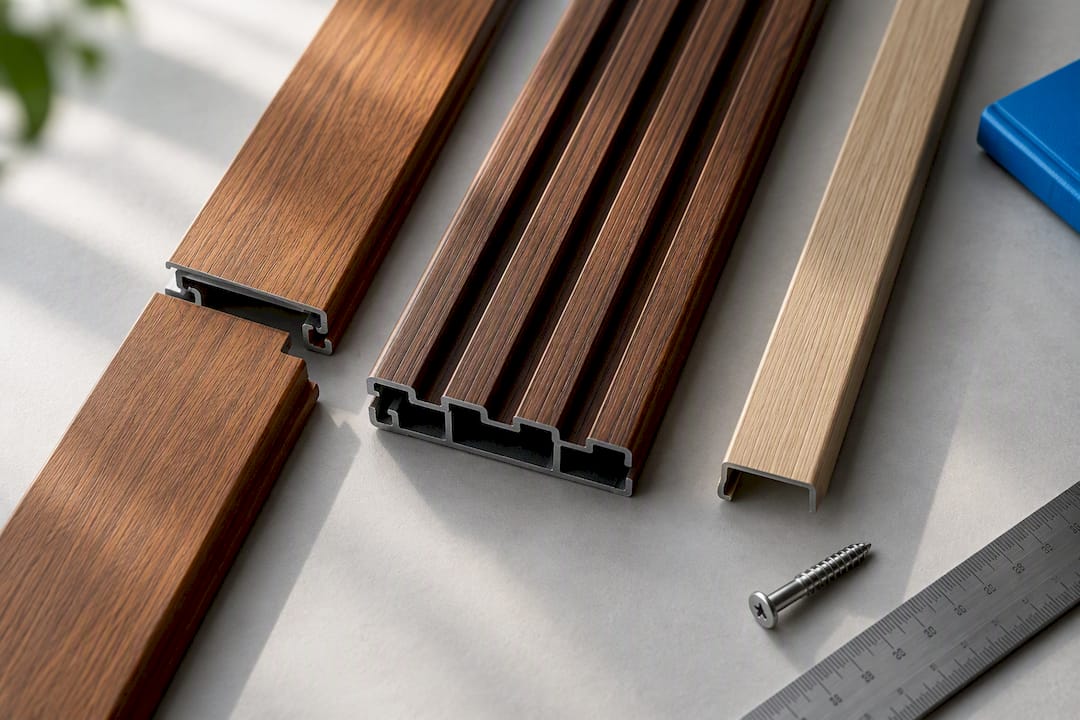
You'll also find different profile types. Self-mating slats interlock edge to edge for a seamless fence face. Ribbed profiles add a subtle timber-grain shadow line. Slim cover profiles hide fixings for a cleaner finish. The woodgrain look itself comes from one of two processes: powder coating with a printed grain pattern baked in, or sublimation, sometimes marketed as PVDF, where the grain is transferred under heat and pressure into the coating layer. Sublimation finishes generally hold their colour and texture longer, and that durability is usually reflected in the price.
Why choose aluminium over real timber for a slat fence?
The case for aluminium comes down to what you don't have to do to it. Real timber warps, splits, cups, and eventually gives termites and rot a foothold, no matter how well it's treated. Aluminium doesn't corrode from insects, doesn't absorb moisture, and won't swell or shrink with the seasons the way hardwood does.
Maintenance is where the gap widens further. Manufacturers commonly state that routine cleaning with mild soap and water is all a woodgrain aluminium fence needs, with no sanding, staining, or resealing ever required. Compare that to a timber fence, which typically needs restaining every two to three years to stop the timber greying and cracking under UV exposure.
Pro Tip: Ask any supplier for their finish warranty in writing, not just a verbal claim. A genuine sublimation or PVDF finish should carry a colour-retention warranty of at least 10 to 15 years, and that document is your proof if the coating fades early.
Some product lines go further, stating non-combustible certification and marine-grade suitability for bushfire zones and coastal properties. Treat those claims as a starting point for questions, not a guarantee. Ask for the actual test certificate, ideally referencing AS3837 for non-combustibility, before you commit to a product for a high-risk site. On the environmental side, aluminium is one of the more recyclable structural metals, which offsets some of the embodied energy from manufacturing when you weigh it against timber that's been chemically treated for outdoor use.
How do you install timber look aluminium slats yourself?
Getting the framing right matters more than getting the slats right. Most slat systems fix onto horizontal carrier rails, which in turn attach to vertical posts set in concrete or fixed to an existing structure. Get this sequence wrong and even the best slats will look sloppy or fail early.
- Set your posts first, spaced according to the manufacturer's datasheet, typically every 1.8m to 2.4m for standard fence heights, but always check the specific product's span rating rather than assuming.
- Fit carrier rails horizontally between posts, using brackets rated for outdoor exposure, and check them for level before fixing slats.
- Cut slats to length with a fine-tooth blade suited to aluminium, and cap or seal any exposed cut ends to stop moisture sitting inside the profile.
- Fix slats to the rails using corrosion-resistant screws or rivets, never standard zinc-plated fasteners, which corrode faster and can bleed rust stains down a light woodgrain finish.
- Set your gap spacing based on privacy needs. A gap of around 10mm to 20mm blocks most sightlines while still allowing airflow, while gaps over 30mm suit decorative screens where airflow and light matter more than privacy.
Complete DIY kits that bundle posts, channels, and end caps cut down on measuring errors and generally give a tidier finished edge than sourcing components separately.
Know when to stop and call someone. Long spans over about 6m unsupported, any slat panel that ties into an automated or swinging gate, and coastal or high-wind sites all push past what a weekend DIY job should attempt. For coastal exposure specifically, marine-grade coatings paired with 316 stainless fasteners aren't optional extras, they're the difference between a fence that lasts and one that's stained and pitted within two years.
Which slat width and finish suits your project?
Width and colour choices shape how a fence reads from the street more than almost any other decision. As a rule of thumb, narrow 38mm slats suit delicate screens, feature panels, or anywhere you want a lighter, more open feel. Wide 100mm slats create a bold horizontal statement and suit larger facades or fences on bigger blocks where a fine slat would visually disappear.
Colour and grain should echo your home's existing palette rather than fight it. Warmer grains like a mid-toned oak or spotted gum tone sit naturally against brick and render, while greyed-out or driftwood tones pair well with contemporary black-framed windows and rendered facades.
Profile choice affects shadow play too. A self-mating profile gives a flat, uniform face with minimal shadow, while a ribbed or slim-cover profile throws a subtle shadow line along each slat that reads as more textured and timber-like from a distance.
Before you order:
- Request a physical sample, not just a photo, colours shift under different light.
- Check colour match on a full-length slat, not a small swatch, since grain patterns can look different stretched over 6m.
- Confirm the finish warranty period and what voids it (improper cleaning products are a common exclusion).
What should you check before buying aluminium slats?
Timber-look slats are sold through trade fencing suppliers, specialist slat brands, and some larger hardware and building supply chains, though stock and range vary a lot by region and season. Before choosing a supplier, ask what documentation they can actually hand over.
- Product datasheet confirming width, thickness, depth, and rated span between posts.
- Finish specification stating whether the coating is powder coat, sublimation, or PVDF, and its warranty period.
- Fire or marine-grade certificates, where relevant, rather than a marketing claim on the box.
- Lead times for custom colours, which often run longer than standard stock shades, plan your project timeline around this.
Price is driven by profile width, finish type, custom length cutting, and freight, more than by the base aluminium cost. Wider slats and premium sublimation finishes sit at the top of the range; standard 65mm powder-coated stock sits closer to the bottom.
What fabricators check on-site that DIYers often miss
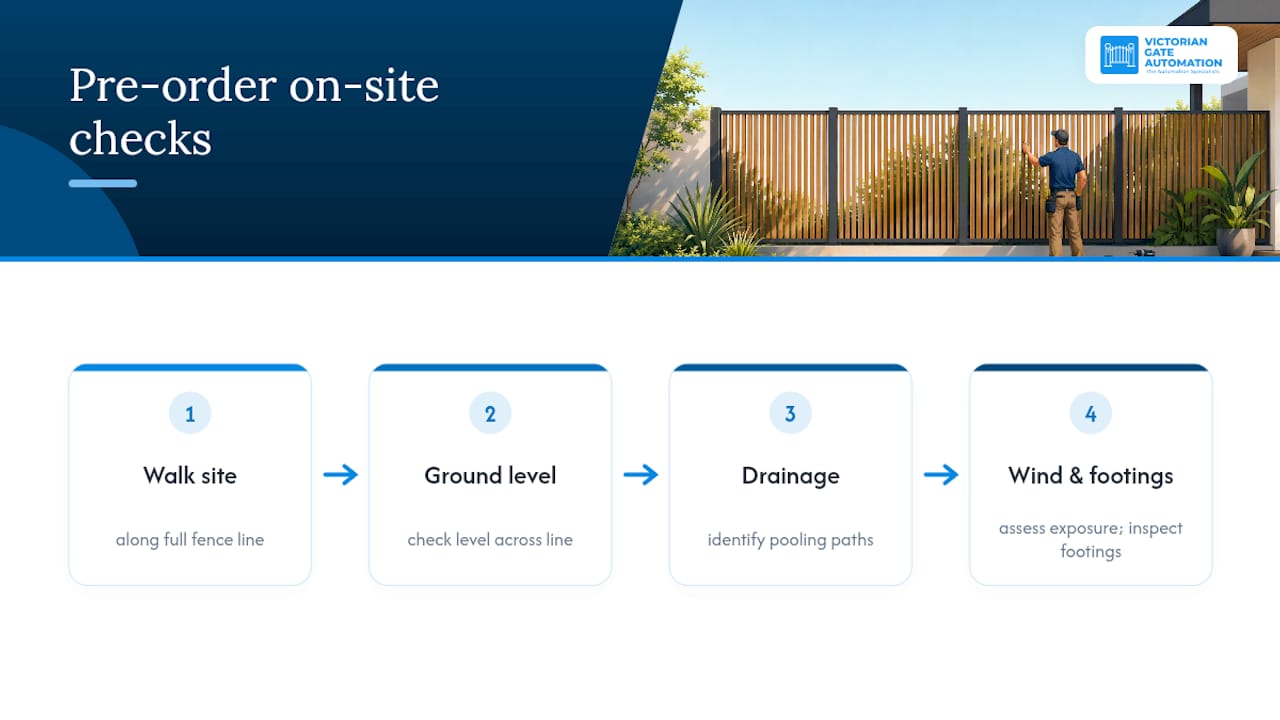
Professional fabricators walk a site before they order a single slat. They check ground level along the full fence line, drainage paths that could pool water against posts, wind exposure across open yards, and the condition of any existing footings before reusing them.
The most common DIY mistakes are undersized framing for the slat span chosen and mismatched fasteners that corrode ahead of the aluminium itself. Bring in a professional when a slat panel needs to integrate with an automated gate, when spans exceed standard bracket ratings, or when the site sits in a coastal or high-wind zone where the margin for error shrinks fast.
What the DIY guides don't tell you
Most guides to timber-look aluminium treat it as a simple swap: take out the timber, put in the aluminium, and you're done. That undersells how much the framing underneath decides whether the finished fence looks crisp or looks like a kit job. I've seen the reasoning behind failed installs come down almost every time to the same root cause: someone matched the slat to the gap they wanted, without checking whether the carrier rail spacing and bracket rating could actually support that span.
The conventional advice obsesses over finish and colour, understandably, since that's the visible payoff. But finish is the last decision, not the first. Get the post spacing and rail selection right against the actual datasheet for your chosen slat, and the finish choice becomes the easy part.
If there's one thing worth prioritising above all else, it's asking for the test certificate before you ask about colour swatches, particularly for coastal or bushfire-prone sites. A beautiful woodgrain finish that fails a non-combustibility check isn't a fence, it's a liability with good marketing.
— Rhys
Get a custom slat fence designed and fitted properly
If your project involves gate integration, a long span, or a site with real wind or coastal exposure, that's exactly where a DIY slat kit hits its limits and a specialist fabricator earns its keep. A reputable local fabricator has extensive experience building custom gates, fencing, and access solutions, handcrafted in-house from locally sourced materials, with a consistent team handling design, fabrication, and installation from start to finish.

That end-to-end approach matters more than it sounds. A fabricator who designs and builds your fence also knows exactly how it was constructed when it comes to future repairs or automation upgrades, rather than guessing at someone else's work. If your timber-look slat fence needs to tie into a swinging or sliding gate, Vicgates' automation and access control services can be planned in from the first sketch rather than retrofitted later, and the wrought iron and custom fabrication team can match slat panels to a feature gate for a cohesive look. Start with a design consult to get your site properly assessed before you commit to materials, or browse the residential gates and fencing page to see what's possible for your property.
Where to check specs and certificates
For a broader comparison of timber and alternative materials on maintenance and finish longevity, the plantation shutter comparison guide from Riverview Shutters covers similar trade-offs in a different application. Always request test certificates directly from your slat supplier before relying on fire or marine-grade claims.
Sources
FAQ
Is there aluminium fencing that actually looks like timber?
Yes. Timber-look aluminium fencing uses powder-coated or sublimation finishes that replicate wood grain and colour, and many product lines are marketed specifically as a timber alternative that resists warping, rot, and pests while keeping a realistic timber appearance.
Are 65mm aluminium slats sold at major hardware chains?
Stock varies by store and region, and range changes seasonally, so it's worth checking with your local hardware chain or a specialist slat supplier directly rather than assuming availability. Trade fencing suppliers and dedicated slat brands generally carry a more consistent 65mm range year-round.
Is aluminium fencing cheaper than timber?
Upfront cost depends on profile width, finish, and length, and aluminium isn't always the cheapest option at purchase. Over the life of the fence, aluminium usually wins on total cost because it needs no restaining, sealing, or termite treatment, expenses that add up fast with timber's ongoing maintenance requirements.
How far can aluminium slats span between posts?
Span limits depend on the specific profile's thickness and depth, so always check the manufacturer's datasheet rather than guessing. As a general guide, most standard fencing profiles are rated for posts spaced between 1.8m and 2.4m apart, with wider or thinner slats needing tighter spacing.
Can I install timber-look aluminium slats myself?
Most standard fencing and screening runs are DIY-friendly, especially with complete kits that include posts, channels, and end caps. Longer spans, gate integration, or coastal and high-wind sites are better handled by a fabricator, and Vicgates can assess those trickier jobs directly.