
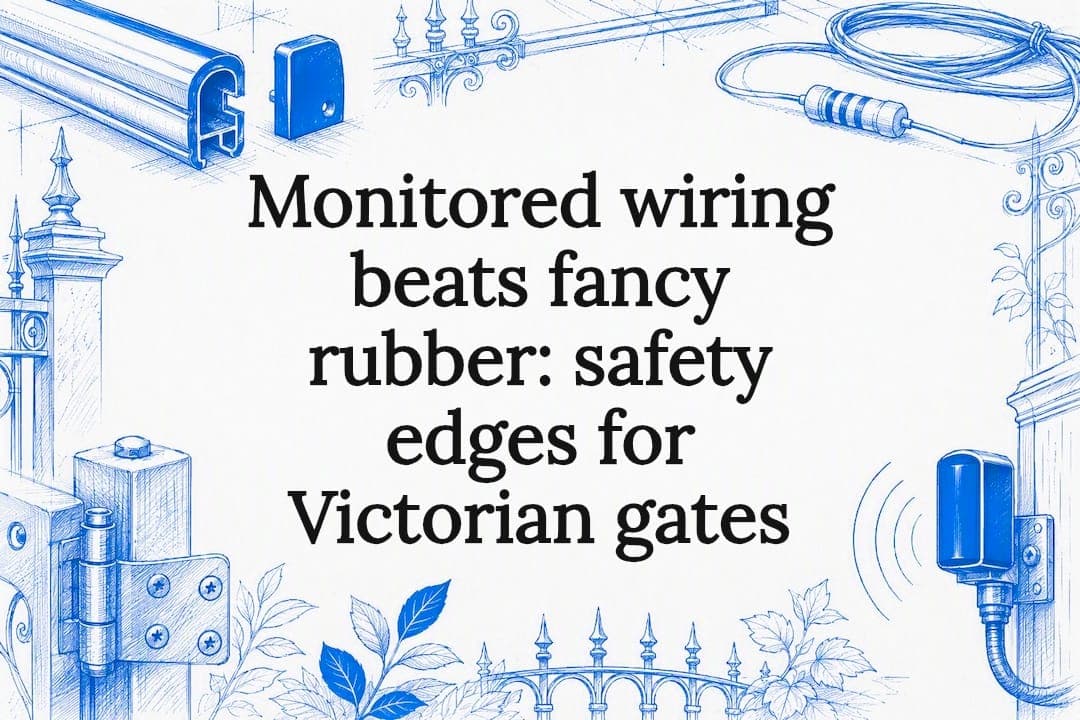
A safety edge is a pressure sensitive strip fitted to the leading edge of an automated gate that stops or reverses the gate the instant it touches a person, vehicle or object. It works as a contact backup to non-contact sensors like photocells, catching what those devices miss. Professional installation with monitored wiring and proper commissioning is what makes the whole system trustworthy, not just the edge itself.
TL;DR:
- Wired resistive safety edges are recommended for high-traffic or high-risk contact points due to their fault detection capabilities.
- Profiles should be selected based on gate weight and speed, with larger sizes providing more cushioning for heavier or faster-moving gates.
- Proper installation, sealing, and regular testing are critical to maintain safety edge functionality and prevent failure from moisture ingress or cable damage.
- Industry standards require monitored wiring, such as resistive circuits or wireless transmission, to detect wiring faults and ensure reliable safety operation.
- Safety edges should be integrated into a comprehensive safety system that includes non-contact sensors for layered protection rather than relying solely on contact devices.
Table of Contents
- What safety edges for gates actually do
- Common profiles, sizes and mounting options
- Where to fit safety edges on swing, sliding and barrier gates
- Electrical monitoring, fault detection and safety standards
- How to choose the right safety edge for your gate
- Installation, sealing, testing and maintenance best practice
- Why professional installation still matters here
- Where the conventional advice on gate safety gets it wrong
- Get your gate safety edges supplied and fitted properly
- Sources
- FAQ
What safety edges for gates actually do
A safety edge relies on physical contact, not motion detection. Inside the rubber profile sits either a conductive rubber chamber, a pneumatic tube, or a mechanical pressure switch. When something presses against the edge, that internal mechanism closes a circuit or forces air through the tube, and the gate operator receives a signal to stop or reverse. The amount of force needed to trigger a response matters more than most people assume. Too sensitive, and the gate stops every time a leaf blows past it. Too stiff, and it fails to protect a small child or a pet before real harm occurs.
Not all safety edges work the same way. Four variants dominate the Australian market:
- Wired mechanical edges use a simple switch, cheap and reliable but with no fault detection.
- Resistive (self-monitoring) edges run a constant electrical signal through the strip so the controller knows instantly if a wire is cut or shorted.
- Wireless edges transmit a signal by radio, useful where running cable is impractical.
- Pneumatic edges use air pressure, common on older or heavy-duty industrial gates.
Because safety edges only activate on contact, industry guidance treats them as a backup layer. Non-contact sensors such as photocells or laser scanners should do the primary detection work wherever that's feasible.
Common profiles, sizes and mounting options
Profile size determines how much energy an edge can absorb before the gate causes injury, and manufacturers label profiles by their cross-section in millimetres. The most common sizes you'll see on supplier datasheets are 25×25, 25×45 and 35×65. The larger the profile, the more cushioning it provides, which matters on heavier gates moving at higher speed.
Mounting comes down to three main approaches:
- Aluminium channel mounting slots the rubber profile into a rigid backing rail, the standard choice for most residential and commercial swing or sliding gates.
- Rubber lip mounting uses a flexible flange that grips an existing frame edge without extra hardware.
- T-foot mounting anchors the profile into a matching groove, giving a cleaner finish on custom fabricated gates.
Buyers can also choose between pre-assembled edges cut to length at the factory or roll stock that an installer trims and finishes on site. Pre-assembled units cost more but reduce installation error. Roll stock suits irregular gate lengths or repair jobs where an exact factory size isn't available.
Visibility and durability deserve a mention too. Bright yellow or striped profiles improve daytime visibility, and UV-stabilised rubber resists cracking far longer than generic compounds. Exposed backing rail, left uncovered by rubber, is a common weak point where fingers or clothing can still get pinched.
Where to fit safety edges on swing, sliding and barrier gates
Placement depends entirely on where a gate can trap or crush something as it moves. The highest risk zones differ by gate type:
- Swing gates need edges on the bottom bar (to catch feet and small pets), on the vertical leading edge where the gate meets its post, and on the hinge side if the gap narrows enough to shear fingers.
- Sliding gates need protection on the leading vertical edge that travels toward the closed position, plus coverage on the motor casing and the receiving post where the gate comes to rest.
- Barrier arm gates typically need an edge along the full underside of the arm, since that's the surface most likely to contact a person or vehicle roof.
A quick home check: stand at the gate's closing point and look for any gap under 25mm that could pinch a finger, or any leading edge with no rubber coverage at all. Full-length vertical strips, running the entire height of the gate leaf, close off the gaps that partial coverage often leaves exposed.
Electrical monitoring, fault detection and safety standards
Industry-standard resistive monitoring for safety edges typically uses a fixed resistor at the circuit's end to continuously read resistance and detect wiring faults before they become safety failures. If a wire is cut, shorted, or corroded, the resistance shifts, and the controller registers a fault and stops the gate rather than letting it run blind. This is a meaningful step up from basic wired switches, which give no warning if a cable fails silently.
Moving gate leaves present a wiring challenge of their own: how do you carry a monitored signal across a hinge or a sliding track without a cable snapping? Inductive transmission systems solve this by passing the signal through coils rather than a physical wire connection, allowing continuous monitoring even as the leaf moves.
Standards installers commonly reference include:
- EN 13241-1, covering industrial, commercial and garage doors and gates.
- EN ISO 13849-1, which defines safety-related control system performance, including the Category 2 or higher safety rating that monitored edge circuits should meet.
- BS harmonised standards, applied alongside the EN framework for UK and Australian-adjacent installations following similar compliance logic.
A gate fitted with an unmonitored edge might look identical to a monitored one from the outside. The difference only shows up the day a wire fails.
How to choose the right safety edge for your gate
Start with the physics of your own gate. A heavy steel sliding gate moving at speed needs a larger profile and a faster response time than a light aluminium pedestrian gate. Match the edge to gate mass, closing speed and the specific points where contact is most likely.
From there, work through these decisions:
- Wired resistive edges for any high traffic or high risk contact point, since fault detection there is worth the extra cost.
- Wireless edges where cable runs are impractical, accepting the trade-off of battery maintenance.
- Pneumatic edges mainly for legacy industrial gates already fitted with compatible controllers.
- Confirm controller compatibility before buying. Not every gate operator reads resistive monitoring signals correctly out of the box.
- Ask about spare parts, waterproofing ratings and end cap availability, since a profile you can't service becomes a profile you eventually replace whole.
Pro Tip: Ask any installer quoting your job whether the edge will be monitored or just wired as a basic switch. If they can't explain the difference clearly, or they skip mentioning a commissioning test altogether, treat that as a red flag rather than a minor detail.
A property manager's guide to access control covers similar ground on monitored fault response, worth a look if you manage multiple gated sites.
Installation, sealing, testing and maintenance best practice
Getting a safety edge fitted correctly is only half the job. Sealing and commissioning are what keep it working months later.
- Mount the profile in its channel, route cabling to avoid pinch points, and seal end caps with drainage orientation in mind, since mounting a profile horizontally sometimes requires removing a seal to stop water pooling inside.
- Test the resistance reading against the manufacturer's spec, confirm the edge triggers stop or reverse only when the gate moves toward an obstruction, and check auto-reverse timing.
- Repeat a basic function test monthly and schedule a full technician check annually, watching for moisture ingress or cable damage as the most common failure points.
Pro Tip: If a gate starts reversing randomly with nothing touching it, check the end caps for water pooling before assuming the whole edge needs replacing. Moisture ingress is a far more common culprit than a failed sensor.
Why professional installation still matters here
Most safety edge failures trace back to installation shortcuts, not product defects: wiring run without drip loops, end caps skipped, or commissioning tests never performed at all. Experienced gate fabricators and fitters have shown in their work the importance of details like correct profile selection for gate mass and speed, monitored wiring done properly the first time, and a commissioning report that confirms the system actually works before anyone relies on it.
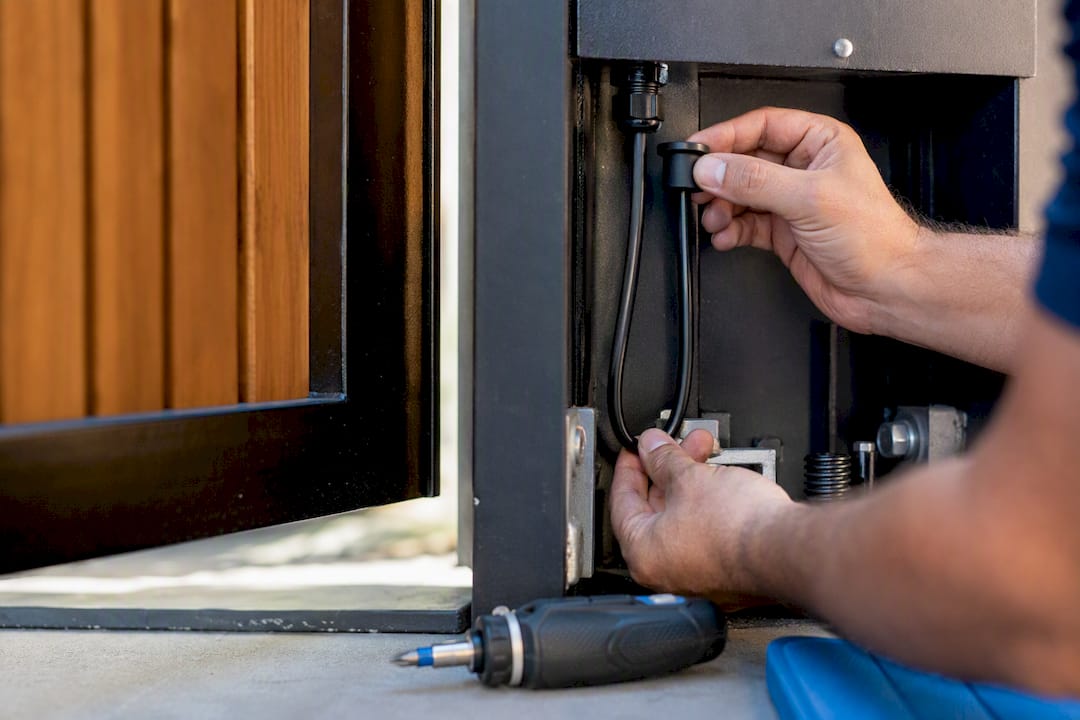
Site assessment and custom fitting are professional-only work, particularly on heavier sliding gates where profile mismatch creates real risk. Reasonable DIY tasks stop at basic visual checks and cleaning. Wiring, resistance testing and commissioning belong with a qualified installer every time.
Where the conventional advice on gate safety gets it wrong
Most guides treat safety edges as a checkbox: fit one, tick the compliance box, move on. That undersells what's actually happening. A safety edge is a last line of defence, not the primary safety mechanism, and treating it as the whole solution leaves gaps that non-contact sensors are better placed to cover.
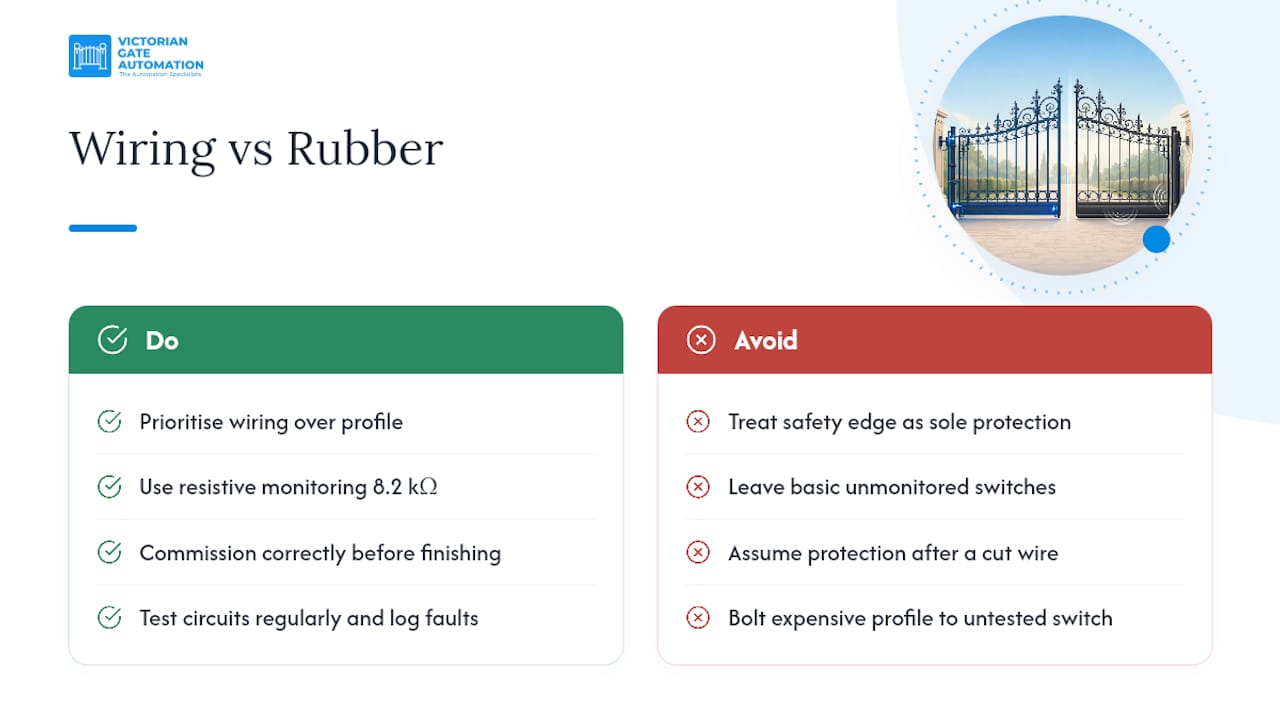
The bigger blind spot is monitoring. Plenty of installations still run basic wired switches with no fault detection, which means a cut wire can sit undiscovered for months while the owner assumes the gate is protected. Resistive monitoring at 8.2 kΩ isn't a premium upgrade for a handful of high risk sites. It's the difference between a system that tells you when it's broken and one that fails silently.
If you take one thing from this guide, prioritise the wiring over the rubber. A cheap profile on a properly monitored, correctly commissioned circuit beats an expensive profile bolted onto a switch nobody ever tests. Get the commissioning right first, then worry about which profile looks best on the gate.
— Rhys
Get your gate safety edges supplied and fitted properly
Safety edges are designed, supplied and installed as part of a full automation package, not as an afterthought bolted onto an existing gate. That means monitored resistive wiring, profile selection matched to your gate's actual mass and speed, and a commissioning test before the job is signed off, reflecting high standards of custom gate fabrication.

A site visit lets us assess your gate's risk points, check controller compatibility and quote a system that meets the safety category your property needs, whether that's a single residential swing gate or a multi-point commercial installation. If you're weighing up options for a new gate or retrofitting safety edges onto an existing one, start with our automation and access control services page and request a quote, or browse our residential gate solutions if you're planning a full gate replacement alongside the safety upgrade.
Sources
- Understanding safety edges: what installers need to know
- Guide to Safety Edge Systems (contactsafetyedges)
- SGE / SCS safety edge datasheet (Omron)
FAQ
What are safety edges on gates?
A safety edge is a pressure sensitive strip fitted to a gate's leading edge that stops or reverses the gate on contact, preventing crushing or dragging injuries. It's a contact based backup, working alongside non-contact sensors like photocells rather than replacing them.
What is a gate edge sensor?
A gate edge sensor is another name for a safety edge, a device built into a rubber profile that detects physical contact and signals the gate operator to stop. Monitored versions use resistive circuits, commonly rated at 8.2 kΩ, to also detect wiring faults.
How do you test a safety edge?
Test by checking the resistance reading matches the manufacturer's specification, then confirming the gate stops or reverses correctly when the edge is pressed while the gate moves toward an obstruction. This should happen at commissioning and again at every scheduled maintenance check.
Are wireless safety edges acceptable?
Wireless edges are acceptable where running cable across a moving gate leaf is impractical, and they're widely used on retrofit projects. They trade the convenience of no wiring for battery maintenance, so confirm the controller supports wireless signals before choosing one.
What are the safety features on automated gates besides edges?
Automated gates typically pair safety edges with photocells, laser scanners or light curtains to detect obstructions without contact. A layered approach like this catches risks a single device would miss, and such combinations are often incorporated into automation projects to enhance safety.