
Clean lines, mixed materials and smart automation define modern gate designs today, and a slatted metal-and-timber gate with the right motor setup will suit most contemporary Australian homes. Horizontal-slat privacy screens, cantilever sliding gates and laser-cut metal panels lead the pack, but the right pick depends on your driveway, façade and how much upkeep you're willing to do. Look good, function well, stay secure: that's the brief.
TL;DR:
- A cantilever sliding gate is ideal for uneven or long driveways, but it requires a stronger frame and higher initial cost than swing gates.
- Automation features like remote control, intercoms, and safety sensors are now standard, with different mechanisms suited for space constraints and driveway shape.
- Proper sizing and matching gate height to fence height within 150mm improve visual harmony and avoid awkward proportions.
- Selecting durable materials and finishes, and considering privacy versus airflow needs, are key to ensuring long-term performance and minimal upkeep.
Table of Contents
- Modern gate styles worth stealing for your own driveway
- Materials and finishes: durability, upkeep and how they change the look
- Automation and access control for modern gates
- Getting the proportions right for your driveway and façade
- Common gate design mistakes worth avoiding
- A practical checklist before you brief a fabricator
- How Vicgates approaches a modern gate brief
- Ready to commission a modern gate that suits your home
- An editorial perspective on where modern gate design is heading
- Sources
Modern gate styles worth stealing for your own driveway
Contemporary gate design has moved a long way past the ornate cast-iron double leaf that dominated suburban entrances for decades. The dominant language now is horizontal or vertical slats, simple frames and a deliberate mix of materials, and it works because it echoes the same clean geometry showing up in modern façades, cladding and fencing. Minimalist gate design leans on that repetition of line rather than ornament, and it reads as considered rather than plain.
Here's where to start looking, depending on what your house and site actually need.
- Slatted horizontal metal or timber gates. The most common contemporary style, and for good reason. Evenly spaced horizontal slats in aluminium or hardwood give you privacy without a solid wall feel, and they suit almost any modern or Hamptons-adjacent façade. Maintenance is low if you go aluminium, moderate if you go timber. Expect this style to sit at the mid-range of most fabrication quotes.
- Mixed metal and timber frames. Pairing a black steel or aluminium frame with timber infill panels gives you structure plus warmth, and it's one of the most photographed styles in contemporary wood-and-metal gate galleries. It suits brick, render or timber-clad homes equally well. The timber needs resealing every few years; the frame doesn't.
- Laser-cut or geometric metal screens. Perforated aluminium or steel panels cut into geometric or botanical motifs add a decorative layer while still letting light and air through. Laser-cut and perforated panels suit architect-designed homes where the entrance is meant to make a statement, but they offer less privacy than solid slats, so think about where the gate sits relative to your windows and outdoor living areas.
- Cantilever sliding gates. These trackless sliders roll on an internal cantilever system rather than a ground rail, which means no channel cut into your paving and no debris jamming a track. They're the go-to for long driveways or uneven surfaces where a conventional sliding track would be a maintenance headache. The trade-off is a heavier, more robust frame, which usually pushes the fabrication cost above a standard swing gate.
- Frameless glass or acrylic panels. Rare, but striking on the right site. Toughened glass set into a slim steel or aluminium frame gives full transparency and works best where security is less of a concern, or where it's paired with an intercom and camera system. It demands regular cleaning and isn't the right call for a busy street frontage.
- Simplified wrought-iron motifs. Traditional wrought iron hasn't disappeared. It's been reworked into cleaner, more geometric patterns that drop the scrollwork in favour of straight bars and simple curves, which lets it sit comfortably against a modern render or brick home rather than a Victorian one.
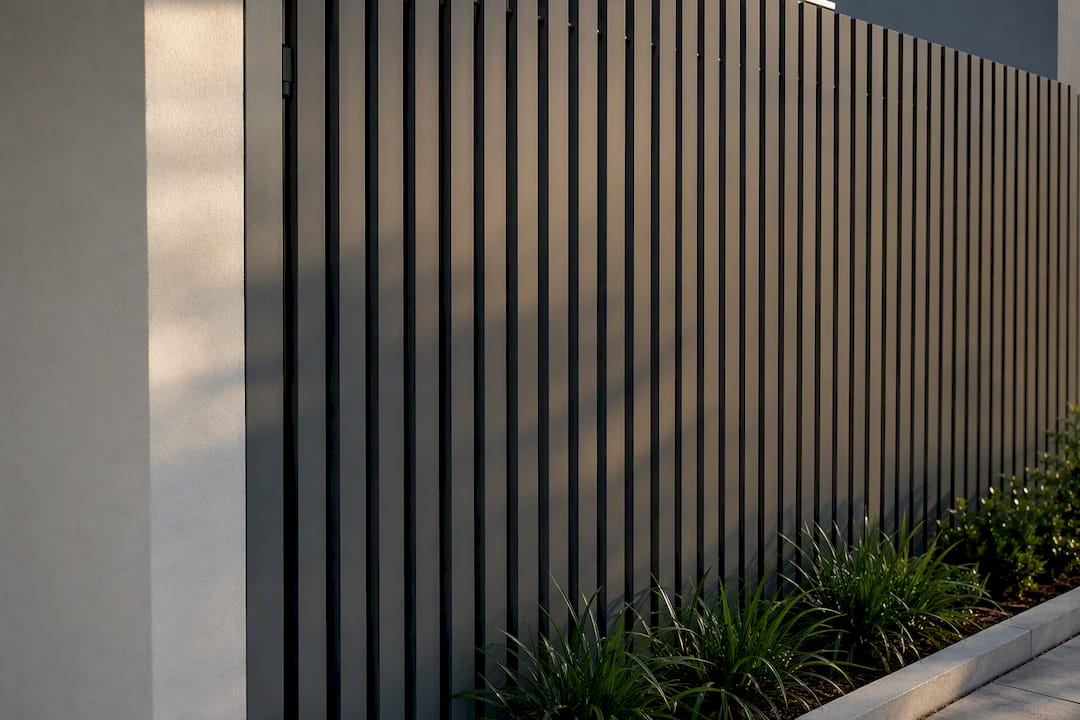
- Vertical slats and partial-perforation panels. Vertical slats give a taller, narrower rhythm that suits compact frontages, while partial perforation (small round or slot cutouts across a solid panel) offers screening with a bit more visual interest than a plain sheet.
Image-led idea boards on sites like Pinterest consistently push these same styles to the top of inspiration searches, which tells you something: buyers respond more to a clear photo of a finished gate than a written description. If you're briefing a designer, bring photos, not just adjectives.
Pro Tip: Repeat the same slat width or spacing across your gate and your boundary fencing. A gate that matches its fence's rhythm reads as one considered design rather than two separate purchases bolted together.
Materials and finishes: durability, upkeep and how they change the look
Material choice decides how your gate ages, not just how it looks on installation day. Steel offers the most strength per dollar and takes a powder coat beautifully, but it will rust at any bare edge or scratch if it isn't properly coated. Aluminium costs a bit more upfront, weighs roughly a third of steel, and shrugs off corrosion, which makes it the default choice for coastal properties or anyone who doesn't want to think about their gate again for fifteen years. Timber brings warmth no metal can fully replicate, but it asks for a resealing cycle every two to four years depending on exposure, and it moves with humidity in ways metal doesn't. Composite or wood-plastic alternatives split the difference: timber-look, weather-stable, and close to zero maintenance, at a price premium over real timber.
Finish matters just as much as base material.
- Powder coating is the standard for steel and aluminium gates because it bonds a hard, UV-stable colour layer that resists chipping far better than paint.
- Hot-dip galvanising underneath a powder coat gives steel an extra corrosion barrier, worth the cost if you're within a few kilometres of the coast.
- Timber sealers and oils need reapplication; a factory-cured hardwood with a UV-stable finish stretches that cycle out.
- Slat spacing and perforation density aren't just aesthetic choices. Tighter spacing means more privacy and less airflow; wider spacing lets light and breeze through but shows more of what's behind it.
Privacy and low maintenance rank among the top priorities buyers report when choosing a front gate design, and the two goals sometimes pull in different directions. A fully solid gate maximises privacy but can trap heat and wind load against the frame; a slatted or perforated gate compromises slightly on privacy for better airflow and a lighter automation load.
Automation and access control for modern gates
Automation is close to a standard expectation on new gate installations now, not an optional extra. Remote control, smartphone app integration and safety sensors are common pairings with contemporary gate designs, largely because modern gate styles (heavier metal frames, wide cantilever sliders) suit motorised operation better than a light swing-and-latch setup ever could.
Your main choice is swing, sliding or bi-fold. Swing suits sites with room to arc the leaf and a level driveway apron; sliding, including cantilever, suits narrow or sloped sites where a swinging leaf would eat into the street or garden; bi-fold splits the difference where you need a wide opening but lack the depth for a full swing.
Beyond the motor itself, think about how people and vehicles will actually get through the gate day to day.
- Intercom systems for visitor screening before you open the gate at all.
- Keypads or PIN entry for tradies, cleaners or family members who don't need a full remote.
- RFID tags or vehicle sensors for hands-free entry as a car approaches.
- Phone app control, useful for granting temporary access to a delivery driver or guest remotely.
Safety hardware isn't negotiable on an automated gate. Anti-pinch edges, photo-eye sensors that stop the gate if something's in its path, and a manual override for power outages should be part of any automation package, and local council rules can affect what's allowed at your boundary line, so it pays to check before you commit to a design. Motors and controllers also come with their own warranty terms separate from the gate's fabrication warranty, so read both before signing off.
Pro Tip: Decide on automation before you finalise the frame design. A heavier cantilever slider needs a stronger internal frame and larger footings than a light swing gate, and retrofitting that after fabrication is far costlier than specifying it upfront.
Getting the proportions right for your driveway and façade
A beautifully designed gate still looks wrong if it's the wrong size for the site. A few rules of thumb keep the scale right:
- Match gate height to fence height, generally within 100 to 150mm, so the entrance doesn't look bolted onto an unrelated boundary.
- Check driveway width against your gate type. Swing gates need clear arc space on both sides; sliding and cantilever gates need a straight run at least as long as the gate leaf itself.
- Align the gate's vertical lines with your garage door, pillars or window mullions where possible. Repeating those lines is what makes an entrance feel designed rather than assembled.
- Leave separate pedestrian access where the driveway gate is wide or automated, rather than making visitors wait for the full vehicle gate to cycle open.
- Consider paving and planting together with the gate, since a well-composed entrance ties gate, fence and hardscape into one visual sequence rather than three separate decisions.
Common gate design mistakes worth avoiding
- Picking a material that fights your climate. Untreated steel near the coast, or timber with no sealing plan in full sun, both age badly within a few years.
- Ignoring clearance requirements for automation. A gate that clips a garden bed or kerb halfway through its swing arc is a design failure, not a motor fault.
- Sizing the gate out of step with the house. An oversized gate on a modest frontage reads as try-hard; an undersized one looks like an afterthought.
- Over-detailing a screen until it stops doing its job. Intricate laser-cut patterns can compromise privacy and collect dirt in every cut edge, adding cleaning time you didn't budget for.
- Skipping safety sensors and compliance checks to save on the quote, which shifts risk onto everyone who uses the gate afterwards.
A practical checklist before you brief a fabricator
Work through purpose, budget, material, automation and maintenance appetite before you get a quote; it saves both you and the fabricator time.
- Define the job. Security, privacy, kerb appeal or all three, and in what order of priority.
- Set a realistic budget range, including automation and site works, not just the gate leaf.
- Shortlist two or three materials that suit your climate and maintenance tolerance.
- Decide swing, slide or cantilever based on your driveway's shape and slope.
- Ask about load capacity, finish warranties, lead time and what site works fall on you versus the fabricator.
- Request a detailed written quote with drawings, safety testing and a clear scope, not a one-line estimate.
- Check for local references and finished examples, ideally on properties similar to yours.
Pro Tip: Ask any fabricator how they handle warranty callbacks on the motor versus the gate structure. A business that separates the two clearly, and stands behind both, is usually the one that's been doing this long enough to know where things actually go wrong.
How Vicgates approaches a modern gate brief
Three decades of fabricating gates and fencing across Victoria has taught us that a good modern design still has to open, close and hold up in real weather, every single day. We build each gate to the site rather than off a catalogue, balancing the clean look a client wants against the frame strength and clearances their driveway actually demands. If you'd like to see finished commercial and residential projects, our case studies and client feedback are worth a look before you brief anyone.
Ready to commission a modern gate that suits your home
Choosing between a slatted aluminium screen, a cantilever slider or a mixed timber-and-steel frame is easier with a local fabricator who builds and installs the whole system rather than just selling you a panel. Vicgates designs, manufactures and installs custom residential gates across Victoria, using locally sourced materials and finishes built for local conditions, and our client testimonials reflect three decades of that same hands-on approach. If automation and smart access are part of your brief, our gate automation and access control services cover everything from swing and sliding motors to intercoms and app-based entry. For a heritage-leaning material with a modern edge, our custom wrought iron work is worth a look too. The next step is simple: get in touch for a site visit and a detailed quote before your next driveway project goes to paper.
An editorial perspective on where modern gate design is heading
Most advice on gate design still treats the gate as a standalone decorative object, something you pick like a light fitting after the house is already finished. That's backwards. The gates that actually work visually are the ones specified alongside the fence, the paving and the façade, not bolted on as an afterthought once the concrete's already poured.
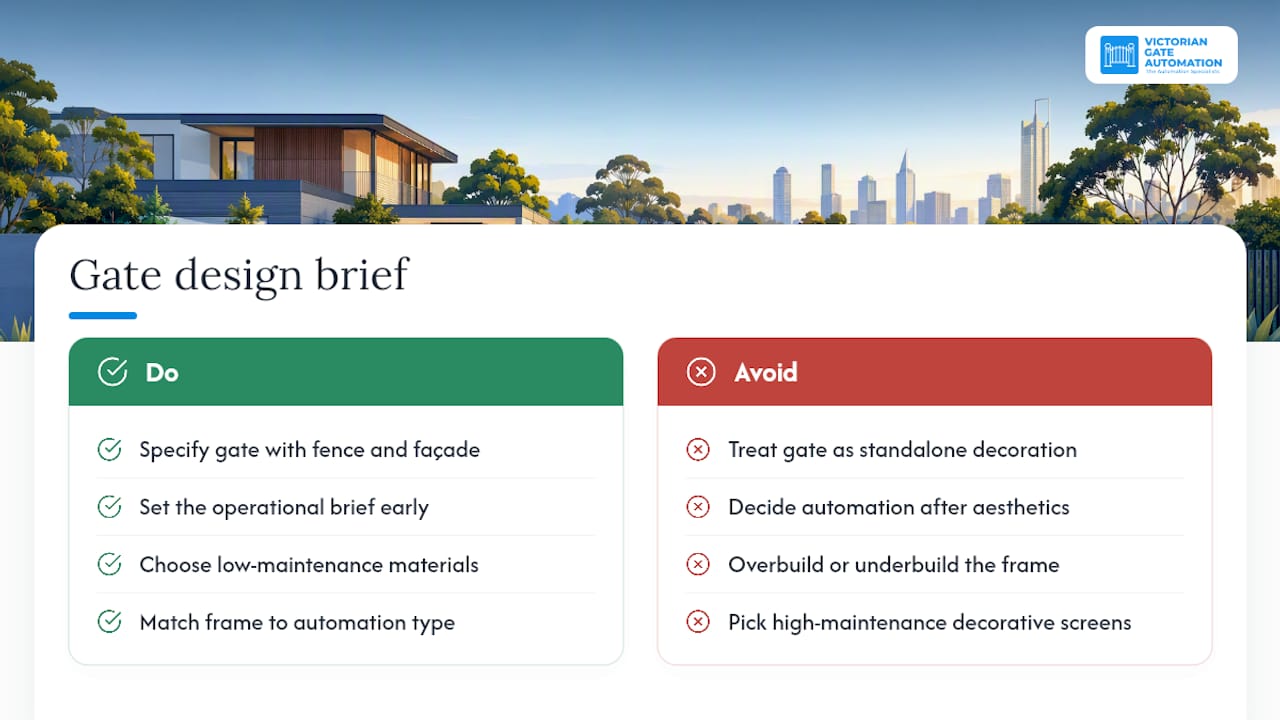
The other thing conventional advice underplays is how much automation should shape the design, not just sit on top of it. A cantilever slider needs a genuinely different frame than a light swing gate, and if that decision gets made after the aesthetic is locked in, you end up either overbuilding an ordinary gate or underbuilding a heavy one. Get the operational brief settled early, alongside the material and the look, and the rest of the decisions get a lot easier.
If there's one bias worth having, it's toward low-maintenance materials over purely decorative ones. A laser-cut screen photographs beautifully on day one. Whether it still looks sharp in year eight, once dust and grime have found every cut edge, is the question worth asking before you commit.
— Rhys
Sources
- 12 spectacular front gate ideas and designs
- Cantilever gate with Afrormosia wood and black steel
- Minimalist and Modern Gate Design