
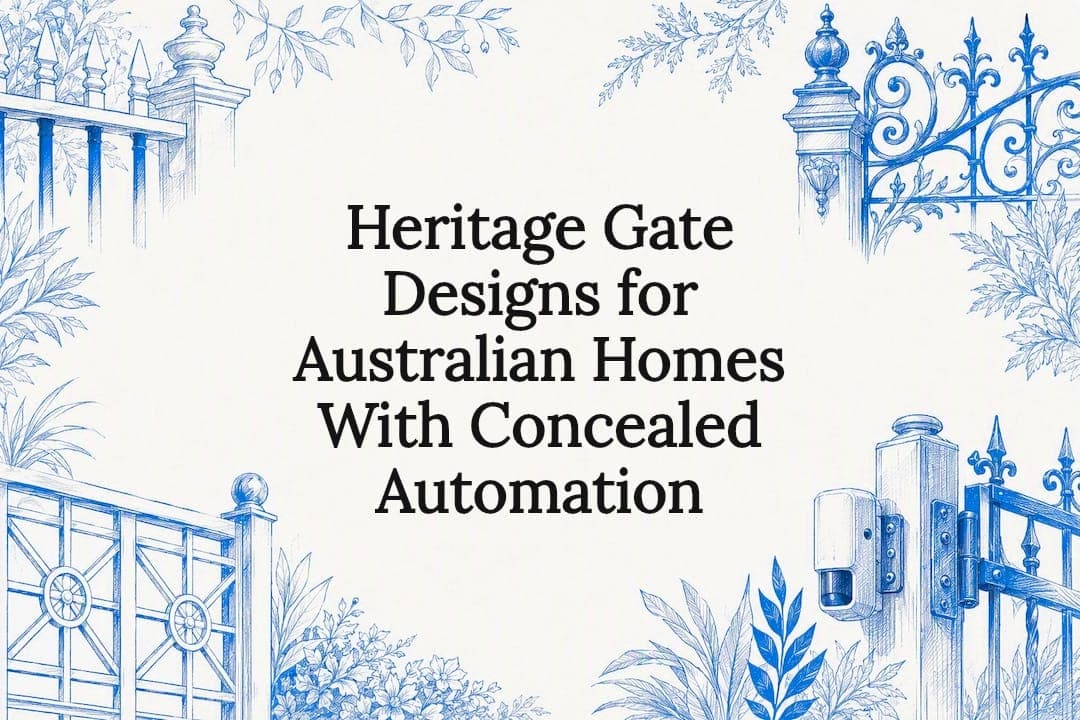
Pick the heritage style that matches your home's construction era, then specify modern materials and concealed automation underneath the period detailing. A Georgian facade wants symmetry and simple pickets, a Victorian terrace wants lace-like scrollwork, and a farmhouse wants honest, sturdy iron. Custom fabrication is what lets you keep that look while hiding the motor, and a local fabricator can build it to suit your exact pillars and fencing.
TL;DR:
- Heritage gates should match the home's period, with Georgian, Victorian, or Edwardian styles specified to ensure authenticity and street appeal.
- Modern steel and aluminium are recommended for durability, with galvanising and powder coating essential to prevent rust and withstand Australian weather.
- Concealed automation systems, such as underground or rimless drives, preserve the period look by hiding motors and hardware from street view.
- Proper site measurement, design approval, and detailed fabrication are crucial to ensure the gate fits, functions correctly, and remains within heritage compliance.
- Regular maintenance, including hinge lubrication and rust prevention, extends the lifespan of custom heritage gates and preserves their historical appearance.
Table of Contents
- Which heritage gate designs suit your home's period?
- What materials and finishes actually last outdoors?
- Which gate type and motion suits your driveway?
- How do you hide the automation in a heritage gate?
- What does commissioning a custom heritage gate actually involve?
- Craftsmanship and aftercare: notes from a local fabricator
- Why heritage gate designs still matter to Australian streetscapes
- Common problems when restoring a heritage gate
- Do you need council approval to change a heritage gate?
- Design perspective: balancing heritage authenticity with everyday use
- How Vicgates builds and maintains heritage gates across Victoria
- Further reading and primary sources
- Sources
- FAQ
Which heritage gate designs suit your home's period?
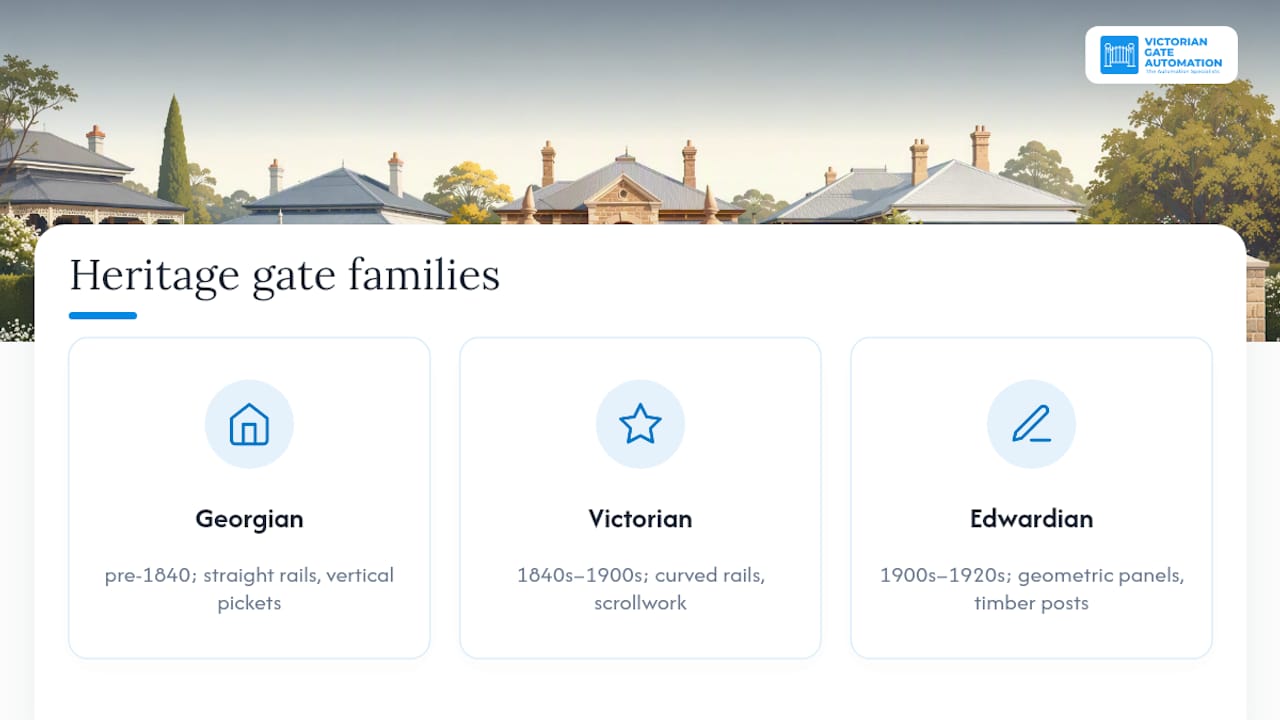
Australia's heritage gate designs generally fall into three architectural families, each tied to a construction era with its own visual grammar. Getting this match right matters more than any other single decision, because a gate from the wrong period looks like a costume, not a feature.
Georgian (roughly pre-1840) favours restraint: straight top rails, evenly spaced vertical pickets, and simple ball or spear finials. It suits symmetrical brick homesteads and colonial farmhouses where the architecture itself does the talking.
Victorian (1840s to 1900s) is where the ornamentation lives. Think curved top rails, cast rosettes, scrollwork panels, and finials shaped like fleur-de-lis or spearheads. It pairs naturally with bullnose verandahs, iron lacework, and the classic Australian terrace.
Edwardian (1900s to 1920s) softens the Victorian excess into cleaner geometric panels, often mixing timber posts with iron infill. It suits federation-style weatherboard and brick homes with less fussy trim.
Historic ornamental gate styles correlate closely with these three architectural eras, which is why a fabricator will usually ask about your home's build date before sketching anything.
When checking your own property, look at three things: the proportion between pillar height and gate height, whether existing fencing uses arched or flat top rails, and the finial style already present on your letterbox or verandah posts. Match those, and the new gate reads as original.
What materials and finishes actually last outdoors?
Wrought iron and hand-forged detail built the heritage look, but true wrought iron is rarely used today. Modern steel and aluminium can deliver the same silhouette with far less upkeep, provided they're specified correctly.
- Steel is the workhorse for driveway gates: thick-walled tube (usually 25mm to 40mm) with welded scrollwork holds its shape under decades of opening and closing.
- Aluminium suits pedestrian gates and lighter panels where weight matters, and it resists corrosion without galvanising.
- Timber works for rural and farm gates but needs more frequent recoating and is rarely the right call for an ornate Victorian pattern.
- Mesh or federation wire infill is a practical option for rural boundary gates where you want the picket look without the fabrication cost of full scrollwork.
Designers now stress that heritage gates need to survive genuinely modern weather and daily use, which means durable base materials and multi-step finishes are not optional extras. A gate that looks period-correct but rusts through in five years has failed at its one job.
The build details matter as much as the material choice. Galvanising before powder coating protects the steel from the inside out, and forged (rather than pressed) decorative elements hold their crispness far longer under UV exposure.
Pro Tip: Ask your fabricator to specify sealed, greaseable ball-bearing hinges and sacrificial anode fixings at the pivot points. It's a small line item on the quote that saves you a sagging, squeaking gate five years down the track.
Which gate type and motion suits your driveway?
Farm and rural properties usually want a single swing leaf on a field gate hinge, simple enough to open with one hand from horseback or a ute window. Suburban driveways with tight turning circles often do better with sliding gates, since a swing leaf needs clear arc space that a sloped or narrow driveway rarely has.
- Swing gates (single or double leaf) suit flat sites with generous pillar spacing and give the most classic heritage silhouette.
- Sliding gates suit sloped or narrow driveways and can hide the drive mechanism behind a return fence.
- Farm field gates prioritise function over decoration, usually a simple five or six bar design in galvanised steel.
- Bi-fold gates suit sites with limited side clearance where a full slide track isn't practical.
Before committing, check your slope, confirm pillar placement allows the leaf to clear the ground through its full swing, and keep the gate height proportionate to your fence line. An oversized gate on modest pillars looks like it was bought for a different house.
How do you hide the automation in a heritage gate?
Custom fabrication is what makes concealed automation possible. Underground pivot systems and rimless sliding drives let a swing or slide gate operate without a visible motor box bolted to the leaf, which is the single biggest thing that ruins a heritage silhouette on an otherwise well-built gate.
- Underground motors suit swing gates where you want zero visible hardware at the hinge post.
- Rimless sliding drives conceal the track and motor behind the gate leaf itself.
- Hidden swing actuators sit inside a widened pillar rather than on the gate face.
Intercoms and keypads belong on a matching pillar face or built into an integrated letterbox, so they read as part of the entrance rather than a bolt-on accessory. Custom heritage gates can genuinely carry this level of integration without giving up the period look, provided the fabricator plans for wiring conduits before the pillars go up, not after.
Photo-eye sensors and auto-stop safety features should be standard talking points with any installer, regardless of how discreet the rest of the system looks.
What does commissioning a custom heritage gate actually involve?
A documented process from measure to handover is what keeps a custom gate project on budget and on time. Skipping steps here is where most delays and surprise costs come from.
- Site measure and consultation — a fabricator visits to check pillar spacing, slope, power access, and existing fencing style.
- Design and drawing approval — you sign off on proportions, finial style, and finish before any steel is cut.
- Fabrication — thick-walled tube is cut, welded, and detailed by hand, then galvanised and powder-coated.
- Installation — pillars are prepared if needed, hinges set, and automation wiring run.
- Commissioning and handover — safety sensors tested, remote access configured, and a maintenance schedule agreed.
A single pedestrian gate typically moves faster through this sequence than a fully automated double driveway gate, which involves motor programming and access control setup on top of the fabrication itself.
Cost is driven mainly by three things: the amount of hand-forged detail, the gate's overall size and weight, and whether automation is included. When you read a quote, check whether galvanising, powder coating, and hinge hardware are itemised separately or bundled. Ask your fabricator directly: what's the warranty period, does it cover the motor as well as the steelwork, and is an annual service included or billed separately? A gate with concealed automation is worth an annual check on the motor, sensors, and hinge tension, ideally written into your aftercare agreement rather than left to memory.
Craftsmanship and aftercare: notes from a local fabricator
Locally made, thick-walled fabrication outlasts mass-produced imports because the steel gauge and weld quality are visible the day it's installed, not just after a decade of use. Hinge selection matters more than most homeowners expect. Compass Ironworks' design guide points to sealed bearings and greaseable ball-bearing hinges as the difference between a gate that swings smoothly for decades and one that sags within a few years.
Sensible hinge placement and hardware also remove entrapment risks that were historically common around large masonry pillars.
A simple aftercare checklist covers most of it:
- Check hinge tension and lubrication every 12 months.
- Inspect powder coat for chips at ground level and touch up before rust starts.
- Test automation safety sensors twice a year.
- Confirm bolts and welds at the pillar mounting point haven't loosened.
Statistic Callout: Custom fabricators with extensive experience have been fabricating and installing custom gates and fencing across Victoria for decades, long enough to see which hardware specs actually survive Australian conditions and which fail early.
Why heritage gate designs still matter to Australian streetscapes
A gate is often the first thing anyone sees of a property, and it has carried that job for well over a century in Australian towns. Georgian gates arrived with the colonial homesteads of the early 1800s, simple and functional because ironwork was expensive and imported. As local foundries developed through the Victorian gold rush era, ornamentation exploded. Lace ironwork became a status symbol, and elaborate gates signalled a household's prosperity as much as its taste.
Edwardian design pulled back from that excess, reflecting a broader shift toward simpler, more geometric architecture across the country. Each period's gates tell you something specific about the technology, trade wealth, and aesthetic values of the decade the house was built. A well-designed heritage gate does more than secure a driveway. It preserves that architectural narrative and functions as a genuine security feature at the same time.
That dual purpose is worth remembering when you're tempted to strip back detail to save on fabrication cost. The finials, the scroll pattern, the proportion of pillar to leaf. These aren't decoration for its own sake. They're the visual language that ties a rebuilt or replaced gate back to the house it fronts, and to the streetscape it sits within. Get it wrong, and even a well-built gate will look like it belongs to a different property.
Common problems when restoring a heritage gate
Rust is the most common issue on original wrought or cast iron gates, usually starting at the base where moisture sits against the ground and at weld points where the original coating has failed. Left untreated, surface rust eventually eats through thin original iron sections, especially on gates fabricated before galvanising was standard practice.
Sagging is the second major problem, almost always caused by worn or undersized original hinges never designed to carry the gate's full weight for a century. Original hardware on many older gates simply wasn't built to the load-bearing standards fabricators use today.
Mismatched repairs cause a different kind of damage. Previous owners patching a broken scroll or replacing a finial with mismatched off-the-shelf hardware breaks the visual consistency that makes the original design work. A restoration project often needs to remake missing decorative elements from scratch, matching the existing pattern by hand rather than sourcing a generic replacement part.
The practical fix for most of these problems is the same: strip back to bare metal, assess which sections are structurally sound, and replace only what's failed rather than the whole gate. Original decorative panels can often be cut out and re-welded onto a new, properly galvanised frame, keeping the authentic ironwork while giving it a structure that will actually last. Where a section is too degraded to save, a skilled fabricator can reproduce the pattern closely enough that the join is invisible once painted.
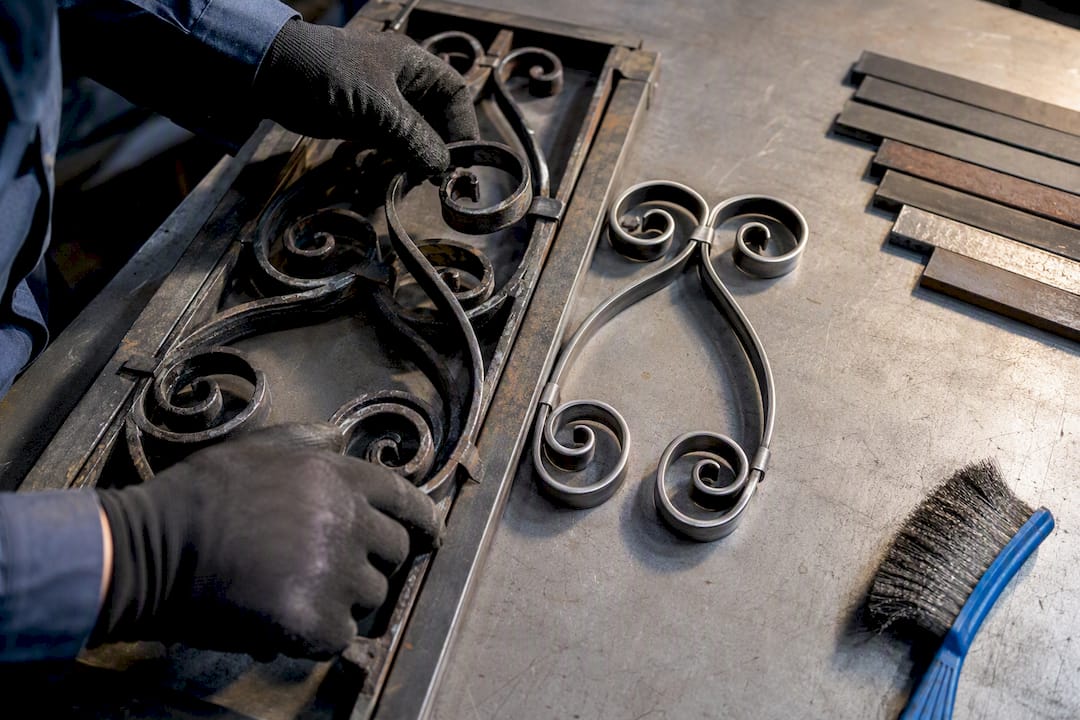
Automation adds a further wrinkle to older gates. Retrofitting a motor onto an original frame not built for repeated mechanical cycling can stress welds that were never designed for the load, which is why many restoration projects rebuild the structural frame while preserving the original decorative ironwork on top of it.
Do you need council approval to change a heritage gate?
Properties on a heritage overlay or listed on a local heritage register usually need council planning approval before altering or replacing a front gate, even when the work looks minor. The exact trigger varies by council and by the specific heritage overlay controls attached to your title, so checking with your local council's planning department before ordering any fabrication is the only reliable way to avoid a costly redo.
Rules generally focus on visibility from the street, gate height, and whether the replacement is "in keeping" with the streetscape's documented character. Some overlays are strict about retaining original materials and forms wherever they can be repaired rather than replaced outright. Others allow replacement as long as the new gate matches the historic style in proportion and detail, which is exactly why matching your gate's period matters as much for approval as it does for looks.
If your property isn't under a heritage overlay, you generally have far more freedom, though front fence and gate height restrictions still commonly apply under standard planning schemes, particularly for corner blocks where sightlines to the street matter for traffic safety.
The practical approach is straightforward: contact your council before finalising any design, keep any correspondence or approval in writing, and brief your fabricator on the exact constraints so the design they draw up doesn't need a rework after the fact. A fabricator experienced with heritage properties will usually have handled this conversation before and can help you frame the application in terms the council is used to approving.
Design perspective: balancing heritage authenticity with everyday use
Chasing perfect period accuracy usually costs you durability, safety, and sanity. The smarter compromise keeps the proportions and a handful of forged accents that read as authentic, then lets modern finishes and concealed automation do the heavy lifting underneath. Nobody standing at the street can tell the hinge is sealed steel, not 1890s wrought iron. They just see a gate that looks right.
— Rhys
How Vicgates builds and maintains heritage gates across Victoria
Experienced fabricators have spent decades fabricating custom gates by hand, using locally sourced steel and iron rather than imported, mass-produced panels that rarely match a period design's exact proportions. Local fabrication allows concealed automation to be integrated into Georgian, Victorian, or Edwardian designs without visible motor boxes, ensuring gates are built to pillars rather than vice versa.

Our services cover the full project: design consultation matched to your home's period, wrought-iron fabrication, motor and access control integration, installation, and ongoing aftercare. If you're restoring an original gate or replacing one entirely, we can also match letterboxes and parcelboxes to the same design language. Browse completed heritage projects to see the range of styles we've built, then get in touch for a site measure and a residential gate quote tailored to your property.
Further reading and primary sources
For deeper background on gate history and hardware standards, see Creative Door Services on ornamental gate origins and the Compass Ironworks gate design guide.
Sources
- Australian Design Review — heritage concerns and constraints still important
- Compass gate design guide 2024 (PDF)
- Ornamental gate designs — Creative Door Services
FAQ
What's the difference between Victorian and Edwardian gate designs?
Victorian gates feature heavy scrollwork, curved top rails, and ornate cast rosettes, while Edwardian designs simplify those shapes into cleaner geometric panels, often mixed with timber posts.
Can I add automation to an existing heritage gate?
Yes, though older frames not built for repeated mechanical cycling often need structural reinforcement before a motor is fitted, which is something an experienced fabricator can assess on-site.
How long does a custom heritage gate take to build?
A single pedestrian gate typically moves through design and fabrication faster than a fully automated double driveway gate, which needs additional time for motor programming and access control setup.
Do heritage overlays affect gate replacement?
Properties under a heritage overlay generally need council planning approval before altering or replacing a gate, with rules focused on street visibility, height, and matching the existing streetscape character.
What materials give the best balance of look and durability?
Thick-walled steel with forged detailing, galvanised and then powder-coated, gives the closest visual match to traditional wrought iron with far less long-term maintenance.