
The safest gate installations never rely on one sensor. Layer a non-contact beam across the opening, add a sensing edge on the leading edge, and fit a vehicle detector where cars or trucks pass through, then have all of it professionally commissioned and tested. Skip any of that and you're gambling on a single point of failure. Read on for how each sensor type works, where to put it, and what a proper installer quote should include.
TL;DR:
- Combining multiple sensor types, such as photoelectric beams and sensing edges, provides essential redundancy for comprehensive gate safety coverage.
- Proper installation must include precise alignment, individual zone testing, and documented force tests to ensure sensors function reliably over time.
- High-weather environments require sensors with appropriate IP ratings, heated enclosures, or double-beam setups to maintain detection accuracy.
- Quotes should specify monitored inputs, entrapment zone protections, and include commissioning and service schedules; unmonitored or incomplete systems pose safety risks.
- Full safety compliance depends on adhering to standards like UL 325 and ASTM F2200, which mandate multiple independent detection methods for each entrapment zone.
Table of Contents
- What are gate safety sensors and how do the main types work?
- Where entrapment zones hide and how to protect them
- How to choose the right sensors: criteria, questions and red flags
- What sensors and installation actually cost
- Installation, commissioning and keeping sensors working
- Standards, and why one safety device is never enough
- Installer perspective: practical takeaways
- How Vicgates gets you a compliant, tested sensor package
- Where to check the technical detail yourself
- Sources
- FAQ
What are gate safety sensors and how do the main types work?
Gate safety sensors are the devices that stop a motorised gate from closing on a person, vehicle, or object. Each type detects a hazard differently, and no single sensor covers every risk on its own.
- Photoelectric beams (photoeyes): these fire an infrared beam between a transmitter and receiver. Break the beam and the gate stops or reverses. They're cheap and reliable in clear weather, but fog, direct sun glare, or a misaligned bracket can cause false trips or, worse, missed detections.
- Reflective sensors: a single unit bounces a beam off a reflector instead of needing wiring at both posts. Handy on long driveways where running a second cable is expensive, though they're generally less robust than a true through beam.
- Sensing edges (PSPE): a rubber or foam strip along the gate's leading or trailing edge that triggers on physical contact. These matter most where a beam simply can't reach, like the pinch point between a sliding gate and its post.
- Inductive loops and virtual loops: loops buried in the driveway detect a vehicle's metal mass; microwave-based "virtual loops" do the same job above ground, which is useful where trenching isn't practical.
- Radar and microwave detectors: units like the OVS-02GT vehicle detection sensor sit above ground, detect vehicles moving up to 35 km/h, and can filter out pedestrians so the gate doesn't stall every time someone walks past.
A quiet rural gate might get away with one beam. A busy commercial entry with mixed foot and vehicle traffic usually needs at least two sensor types working together.
Where entrapment zones hide and how to protect them
An entrapment zone is any point where a moving gate can trap a person or vehicle against a fixed object, a post, a wall, a fence line. Missing even one of these zones is how gates injure people, and it's rarely the zone anyone expects.
- The leading edge of a sliding gate, where it meets the latch post. A sensing edge here catches contact the moment it happens, before real force builds.
- The gap behind a swinging gate, between the open leaf and an adjacent wall or fence. This one gets missed constantly because it's only dangerous when the gate is open, not closing.
- The primary vehicle path through the opening. A photoelectric beam set at bumper height, or a radar detector for longer driveways, covers this zone without nuisance trips from birds or leaves.
- Pedestrian crossing points if people share the vehicle entrance. Wherever budget allows, separate a pedestrian gate from the vehicle gate entirely rather than relying on sensors to cover both.
- The gate's own moving structure, for sliding gates with exposed rollers or tracks where clothing or limbs can catch.
Mount beams at two heights on high-traffic sites to catch both adults and children, and keep sensor brackets rigid. A beam that drifts out of alignment after a fortnight of wind isn't protecting anything.
How to choose the right sensors: criteria, questions and red flags
Choosing sensors is less about brand and more about whether the whole system is designed as one unit. An operator with a good reputation still needs external devices matched to it, wired so the gate refuses to run if a sensor fails.
Run through this before signing anything:
- IP rating suited to the site. An unsheltered coastal driveway needs a higher-rated enclosure than a sensor tucked under an eave.
- Monitored inputs, meaning the control board actively checks that each safety device is present and working, not just wired in.
- Compatibility with your existing or planned gate operator, brand and protocol matched, not forced together.
- Spare parts availability, because a sensor nobody stocks locally means weeks of an unsafe gate running on bypass.
- Documented commissioning, a written record of what was tested and when, not a verbal assurance.
Ask any installer quoting the job: which entrapment zones will be protected, which devices are monitored versus just wired in parallel, how often the system will be serviced, and what the warranty actually covers if a sensor fails within a year. If a quote offers a single unmonitored photoeye and calls the job done, that's a red flag. So is any installer who can't describe a force test or produce a commissioning checklist.
Pro Tip: Ask to see a sample commissioning report from a previous job before you sign. If the installer can't produce one, they probably don't do them.
What sensors and installation actually cost
Supply-only prices for a single photoelectric beam pair typically sit at the lower end of the sensor market, with sensing edges and reflective units in a similar bracket. Radar and vehicle-detection units cost more, reflecting the added electronics and weatherproofing.
Installation is usually where the real cost difference shows up:
- Labour and cable runs, especially trenching for inductive loops
- Integration with an existing operator or control board
- Commissioning and force testing, which takes real time if done properly
- Multiple entrapment zones needing separate devices, rather than one sensor doing double duty
Expect higher totals for monitored systems, harsh outdoor sites needing heated or extra-rugged enclosures, and any commercial gate covering several zones at once. When comparing quotes, check whether commissioning and a service visit are actually included, or just the hardware.
Installation, commissioning and keeping sensors working
A sensor that's never been properly commissioned is a sensor you can't trust, regardless of how good the hardware is.
- Align every beam and confirm the receiver reliably detects a break at the full width of the opening, not just near the transmitter.
- Test each entrapment zone individually, checking the gate stops or reverses correctly when that specific zone is triggered.
- Run force tests where the operator's closing force is checked against safe limits, not just how it "feels" by hand.
- Verify monitored inputs, confirming the control board actually refuses to run when a device is disconnected or faulty.
After that, routine maintenance keeps it that way: a visual check of beams and edges each visit, lens cleaning (dust and cobwebs cause more false trips than people expect), and a full function test on a set schedule rather than only when something breaks.
Ask for service records every time, and insist on documented results, not a tick on an invoice. HSE guidance is explicit that safe operation depends on how devices are wired, monitored, and tested over the gate's working life, not just how they performed on install day. Environmental exposure matters too: industry guidance from Fencing Industry Australia notes that weather changes sensor reliability, which is why exposed sites often need heated housings or double-beam setups rather than a single unprotected unit.
Standards, and why one safety device is never enough
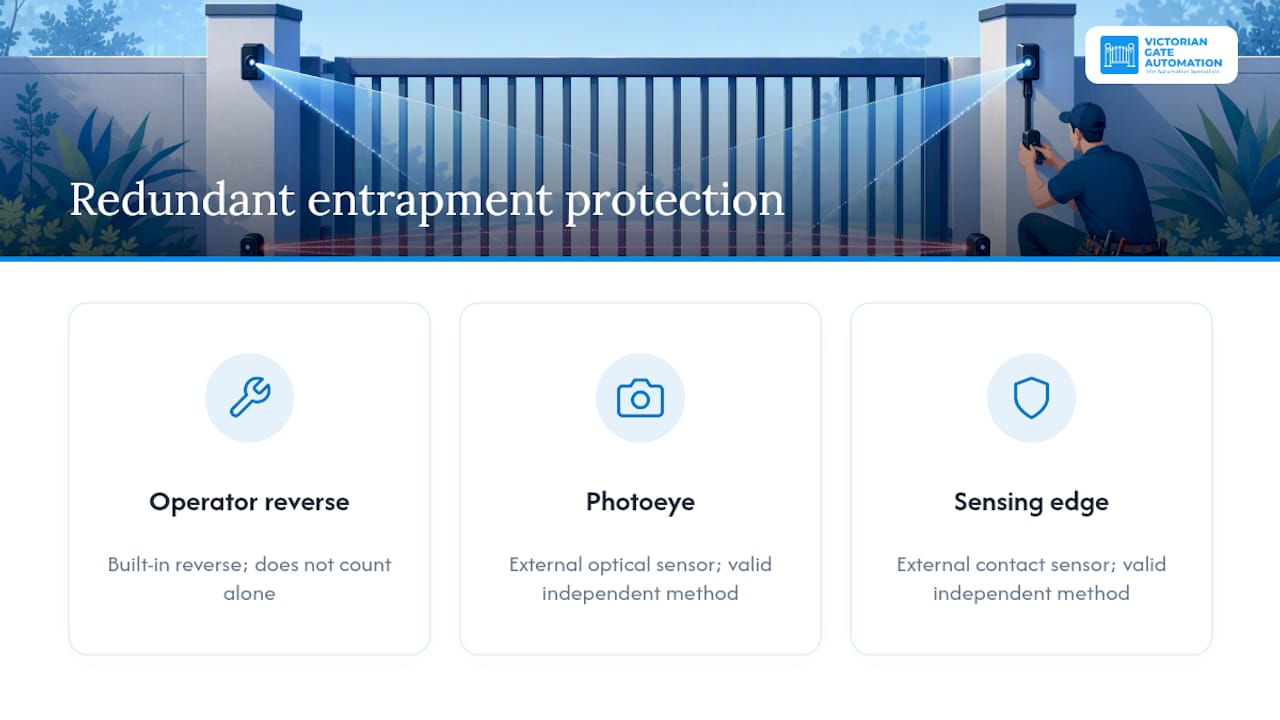
Standards exist because a single safety device fails eventually, whether from weather, wiring faults, or simple wear. UL 325 and ASTM F2200 require more than one independent entrapment-protection method per entrapment zone. An operator's built in reverse-on-obstruction feature doesn't count as that second method on its own; it needs a genuine external device like a photoeye or sensing edge alongside it.
The principle behind this is redundancy: if one device misses a detection, a second, independent device should still catch it. That's why a photoeye plus a sensing edge on the same zone is common practice, not overkill. Ask your installer to confirm which standards apply in your jurisdiction and to document the tests performed against them, because requirements do shift between regions and gate types, and a generic answer isn't good enough here.
Installer perspective: practical takeaways
Every callout I hear about starts the same way: a sensor was cheap, unmonitored, or never tested after install. The gates that never cause problems are the ones with layered protection and a service history to prove it. If you're unsure what your gate has right now, get a qualified installer out for a site survey before assuming the existing sensors are enough.
— Rhys
How Vicgates gets you a compliant, tested sensor package
A practical alternative to piecing sensors together yourself or accepting a bare-minimum install is to have the sensor package specified alongside the gate itself during design rather than bolted on afterwards. Every hardware choice, beam placement, and edge position should be worked out during design, ideally with locally sourced materials and end-to-end service from the first drawing through to installation.

That matters most on properties with awkward entrapment zones or mixed pedestrian and vehicle traffic, where a generic sensor kit often misses a hazard a custom design would have caught. Vicgates handles the full job: site assessment, sensor selection matched to your gate and site conditions, installation, and commissioning, whether it's a straightforward residential drive or a commercial or industrial gate system with multiple zones to protect. For homeowners, the residential gates and fencing service covers the same ground on a smaller scale, and the automation and access controls page details what a turnkey install actually includes. If your current gate has never had a documented safety check, request a design consult and get a proper site survey booked before you assume it's fine.
Where to check the technical detail yourself
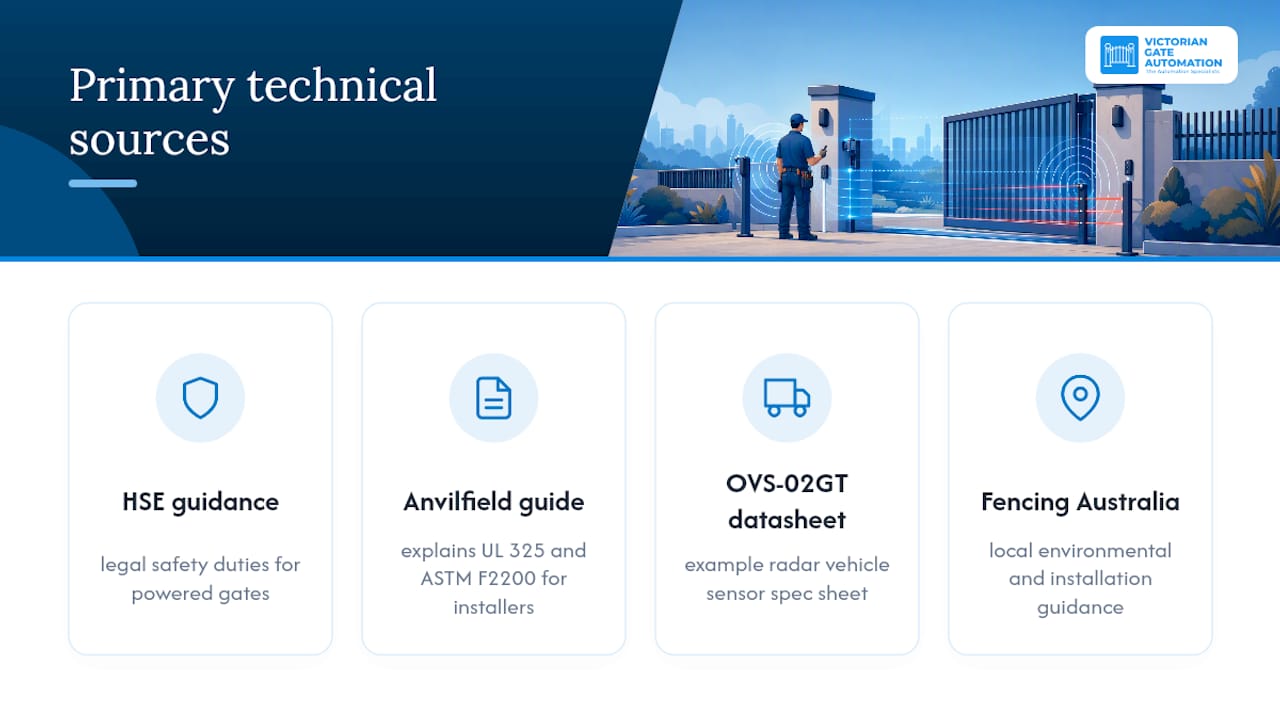
For readers who want the primary sources rather than a summary: HSE's guidance on powered gates covers legal safety duties in detail, the Anvilfield field guide explains UL 325 and ASTM F2200 requirements for installers, the OVS-02GT datasheet shows what a radar vehicle sensor spec sheet actually lists, and Fencing Industry Australia's code of practice sets out local environmental and installation guidance.
Sources
- Ensuring powered doors and gates are safe - HSE
- Automatic gate operator installation field guide - Anvilfield
- Code of practice for gates and automation (Fencing Industry Australia)
FAQ
What are the best gate safety sensors?
There's no single "best" sensor because each type protects a different hazard. The strongest setups combine a photoelectric beam or radar detector across the vehicle path with a sensing edge on the leading edge, so no single point of failure leaves an entrapment zone unprotected.
How much do gate safety sensors cost?
Supply-only prices vary by sensor type, with photoelectric beams and sensing edges generally at the lower end and radar or vehicle-detection units costing more due to their added electronics and weatherproofing. Installation, trenching, and commissioning usually add more to the total than the hardware itself, so always confirm what's included before comparing quotes. Vicgates provides project-specific pricing after a site assessment; current details are available directly through Vicgates.
What are gate sensors called?
Gate sensors go by several names depending on the market and device: photocells, photoeyes, and photoelectric sensors all refer to beam-based detection, while sensing edges, inductive loops, and radar or microwave detectors cover contact and vehicle-presence detection. The terminology varies, but the underlying technology falls into these same core categories.
How do gate sensors actually detect an obstruction?
Photoelectric beams detect a break in an infrared light path between a transmitter and receiver, while sensing edges detect physical contact along the gate's moving edge. Radar and microwave units, like the OVS-02GT, detect a vehicle's movement and speed above ground without needing a buried loop.
Do I need more than one sensor on my gate?
Yes, in most cases. UL 325 and ASTM F2200 both require more than one independent entrapment-protection method per zone, because relying on a single device leaves no backup if it fails or is misaligned.