
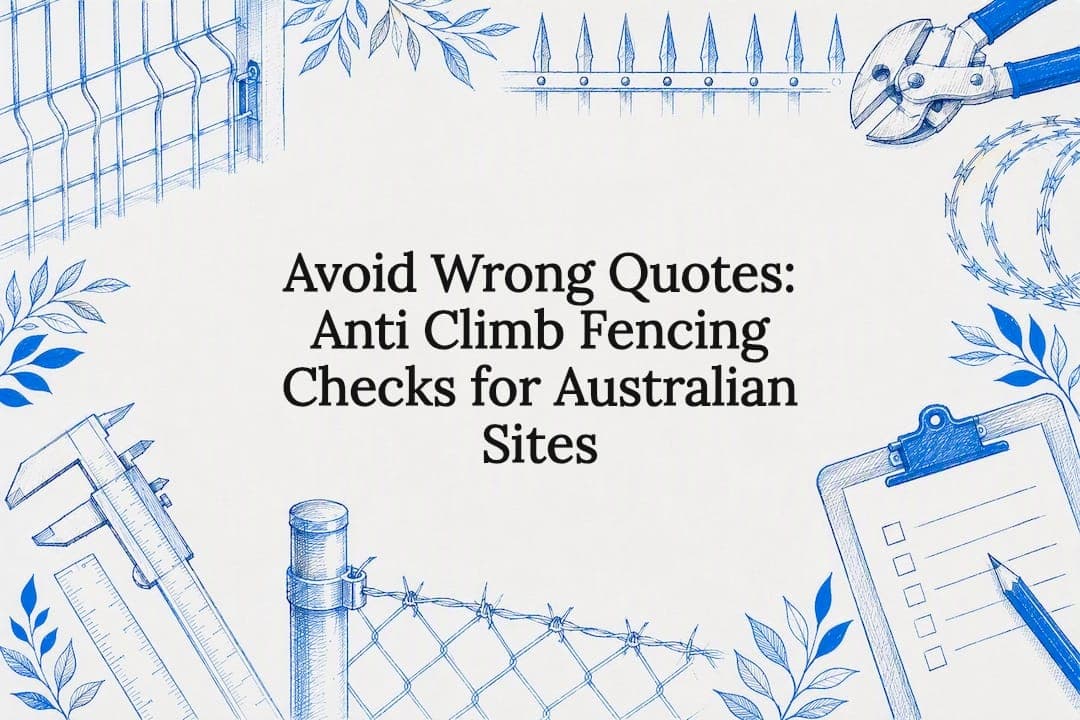
Anti climb fencing stops intruders by removing every handhold and foothold, using a tight welded mesh (the industry-standard 358 pattern) instead of rails or gaps that boots and fingers can grip. For most sites, the right move is welded 358-style mesh at 2.1 metres or higher, chosen after a proper site survey. Done well, it buys you delay, a strong visual deterrent, and a fence that plays nicely with cameras and sensors.
TL;DR:
- A small aperture of the welded mesh, typically 358 pattern, is essential to deny hand and foot holds, making climbing physically difficult.
- Wire thickness and quality coating, especially galvanising with powder coating, significantly increase resistance to cutting, bending, and corrosion.
- The fencing height should be measured above finished ground level, not just panel height, to ensure effective deterrence.
- Pairing anti climb fences with active sensors, CCTV, and physical deterrents like razor wire enhances real-time security response.
- Proper installation involves site-specific assessments, correct post spacing, and ongoing maintenance to ensure long-term performance.
Table of Contents
- What is anti climb fencing and how does it stop scaling?
- Which anti climb fencing types suit your site?
- What specs should you check on the datasheet?
- Where does anti climb fencing actually get used?
- How do you choose an installer and avoid the wrong quote?
- What toppers and sensors make anti climb fencing stronger?
- What does proper installation and upkeep actually involve?
- What decades of fabrication work teach you about anti climb fencing
- How Vicgates handles your anti climb fencing project
- Sources
What is anti climb fencing and how does it stop scaling?
Anti climb fencing works on a simple principle: if there's nothing to grab, there's nothing to climb. The mesh aperture is small enough that fingers and toes can't get purchase, and the wire itself is welded rather than woven, so cutting or prying apart the panel takes real time and the right tools.
You'll see the term "358" thrown around constantly in this space. It's an old imperial reference to the mesh dimensions, but the product datasheets that matter today quote metric aperture and wire diameter, and that's what you should be comparing, not the marketing name.
No fence, however good, is truly unclimbable. Every security fence is best understood as a delay mechanism, not an absolute barrier, which is exactly why detection matters as much as the mesh itself:
- Small aperture denies usable hand and foot holds, even for someone determined and fit.
- Welded construction resists bolt cutters and prying far better than woven wire or timber palings.
- The delay principle means a fence without cameras or alarms is only doing half the job.
Which anti climb fencing types suit your site?
Welded 358 mesh dominates the anti-climb category for good reason, but it isn't the only option, and it isn't always the right one.
- 358 welded mesh — the benchmark for critical infrastructure, substations, and high-value commercial sites. Small aperture, strong visibility for surveillance, moderate cost.
- Palisade fencing — vertical steel pales with pointed tops. Good deterrent value and a more traditional look, but the horizontal rails between pales can offer partial footholds if spacing isn't tight.
- Expanded or perforated metal — solid-looking panels that block sightlines as well as climbing. Heavier and pricier, often used where privacy matters as much as security.
- Concrete or masonry walls — the most climb-resistant option by mass alone, but expensive, slow to install, and poor for CCTV visibility.
Whatever you land on, check the finish. Galvanising, then powder coating on top, is the combination worth asking for on any quote, and it's the detail budget systems skip first.
What specs should you check on the datasheet?
A supplier's product datasheet and architectural specification sheet are the two documents you want in hand before signing anything, according to Profence's guidance on 358 mesh. Everything else is marketing copy until you've read these.
- Aperture size — the smaller the gap, the fewer usable holds. This is the single number that determines whether a fence genuinely qualifies as anti-climb.
- Wire diameter — thicker wire resists cutting and bending longer, and it's usually where budget systems cut corners.
- Coating type — galvanised-then-powder-coated steel outlasts single-layer finishes, particularly near coastal or industrial sites.
- Height — ask for the height above finished ground level, not the panel height alone.
Where does anti climb fencing actually get used?
Anti climb mesh started life protecting substations, water treatment plants, and other critical infrastructure sites where a breach isn't just theft, it's a public safety event. That's still where it's most common, but the residential and commercial cases have grown just as fast.
- Commercial carpark perimeters and loading dock boundaries where after-hours access matters.
- School and childcare perimeters, where the fence needs to keep kids in as much as intruders out.
- Rooftop plant areas and pool fencing on multi-storey residential builds.
- High-value residential boundaries where owners want visibility for CCTV rather than a solid wall.
The visibility question is worth sitting with, especially when considering what kind of doors are best for interiors to balance visibility versus solidity in your security design. Mesh keeps sightlines open for cameras and passive surveillance, while solid panels trade that away for privacy and noise dampening. Pick based on what your site actually needs, not what looks more imposing in a brochure.
How do you choose an installer and avoid the wrong quote?
Getting three quotes for "anti climb fencing" often means comparing three completely different scopes of work dressed up in similar language. Here's how to keep them honest.
- Insist on a site visit before any fixed price. A phone quote can't account for slope, adjacent structures, or the soil conditions your footings need.
- Ask for the aperture, wire diameter, and coating spec in writing, not just "358 mesh" as a catch-all term.
- Ask how they mitigate adjacent climb risk — a fence installed hard against a retaining wall or transformer box is only as strong as its weakest metre.
- Check warranty terms on coatings specifically, since corrosion is what actually fails first on most systems, not the mesh itself.
- Confirm where fabrication happens. Locally fabricated panels are usually easier to match, repair, or extend later than imported stock lines.
Pro Tip: If a quote doesn't mention height above finished ground level, ask why. It's the single easiest number for a supplier to fudge without technically lying.
Red flags worth walking away from: no written aperture spec, no willingness to visit the site, and vague answers about who actually welds the panels.
What toppers and sensors make anti climb fencing stronger?
A bare fence, however good the mesh, is a passive barrier. Pairing it with active detection is what turns delay into a genuine security response.
- Inward-leaning brackets add a physical overhang that's far harder to get a leg over than a straight top rail.
- Razor wire and additional strands boost deterrent value, though local rules on visibility from public land are worth checking before you commit.
- Vibration sensors and fence-mounted detection cable flag a climb attempt in real time, rather than after the fact.
- CCTV and linked alarms close the loop, since the whole point of a fence is buying time for a response, not preventing entry forever.
What does proper installation and upkeep actually involve?
Installation quality decides whether your anti-climb fence performs on day one, let alone year ten. A climb-risk survey should map anything within roughly 1.5 metres of the fence line, since a wheelie bin, a stack of pallets, or an overhanging branch can undo the whole system. Drainage and anti-dig detailing at the base matter just as much as height.
- Post spacing and footing depth need to match the soil, not a generic spec sheet.
- Gate junctions and corners are where most climb attempts actually succeed, so detailing there deserves extra attention.
- Corrosion checks, coating touch-ups, and sensor calibration should sit on a maintenance calendar, not a "call us when it fails" basis.
Integrated systems like the Guardian 7000 show what a fully tested, modular high-security setup looks like when sensors and anti-ram provisions are built in from the start, rather than bolted on later.
What decades of fabrication work teach you about anti climb fencing
The surprises are rarely in the mesh. They're in the ground: a retaining wall nobody mentioned, a boundary that isn't where the title plan says it is, drainage that floods the footings every second winter. Custom gates and fencing fabrication in Victoria benefits from locally sourced materials, and the pattern holds across many jobs: the spec sheet only tells you half the story. Insist on a site visit and get every measurement documented before steel gets ordered.
— Rhys
How Vicgates handles your anti climb fencing project
The alternative to a one-size-fits-all fence order is custom-fabricated anti climb mesh, palisade, or wrought iron systems, designed around your actual site rather than a catalogue panel size. That means the aperture, height, and finish are chosen to suit your boundary, your climb risks, and your budget, not adjusted after the fact.
Every project starts with a site visit, because a fence quoted over the phone is a fence that gets re-quoted on installation day. Vicgates fabricates locally, matches finishes to your existing gates or wrought iron features, and can pair your new fencing with automated access control for a single integrated security upgrade. For commercial sites needing a full perimeter overhaul, the commercial services page covers larger-scale fabrication and installation work, while homeowners can start with the residential security page to see what a domestic install typically involves. If you're ready to move past guesswork, book a site visit and get a written quote with real specifications on it.
Sources
- What Is Anti-Climb Mesh? A Guide to 358 Security Fencing | Profence
- Climb Resistant Fences And Anti Climb Fences | Protogetic
- How Anti-Climb Fencing Works to Stop Unauthorized Access
- ULTRA HIGH SECURITY FENCE SYSTEM | Guardian 7000 | Betafence